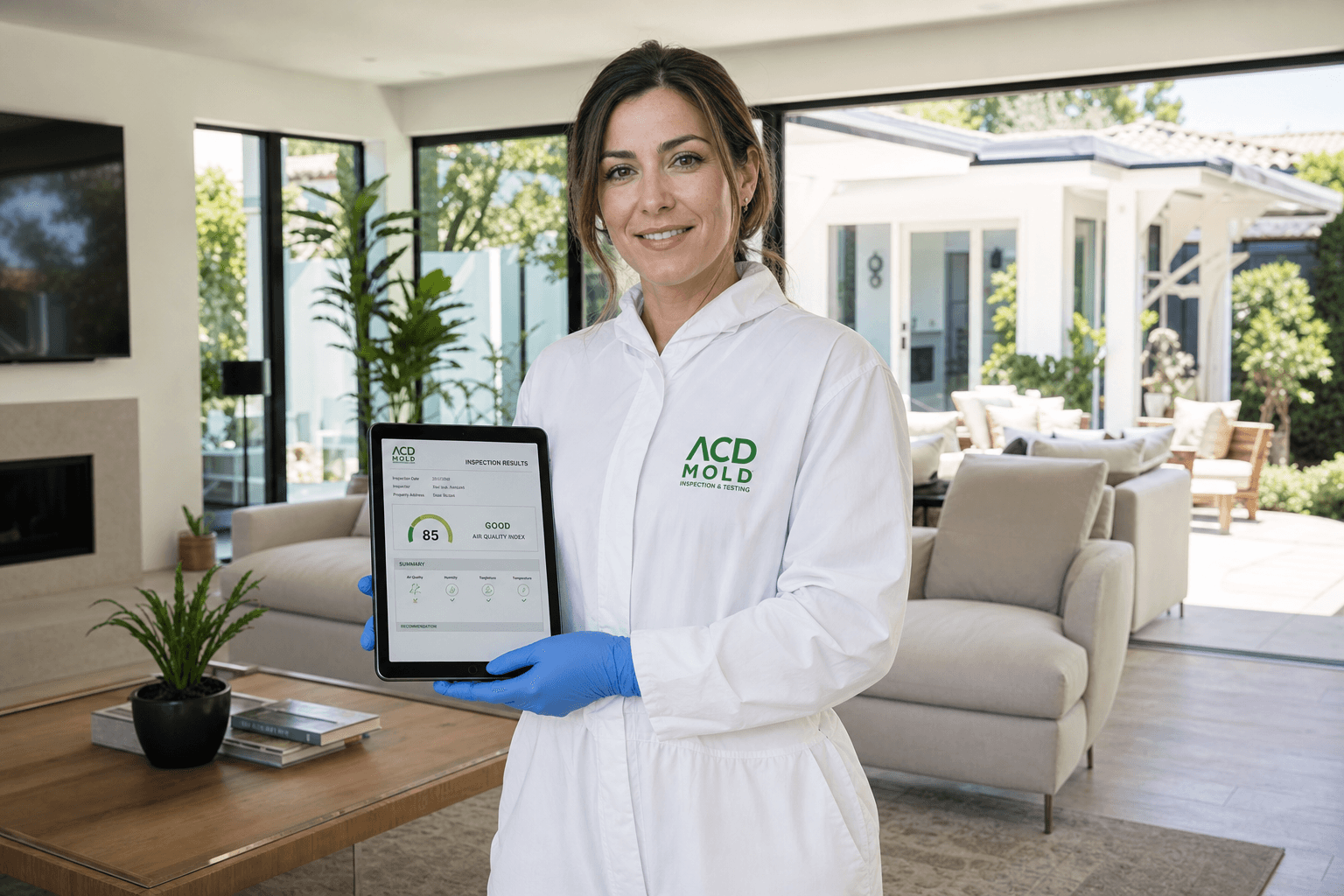
A mold inspection in Woodland Hills is a non-invasive look at where moisture is collecting in your home or building and whether conditions could be supporting mold growth. ACD Mold is an independent inspection and testing company based in nearby Encino, and our inspectors travel to you across the 91364 and 91367 areas, from the ranch streets of Walnut Acres to the mid-rise condos and commercial floors of Warner Center. Because we diagnose and test but are never the ones paid to do the physical removal, what we report about your property carries no pressure to sell you a demolition job.
What a Woodland Hills mold inspection actually covers
The goal of an inspection is to answer two practical questions: is there a moisture problem, and is there visible or suspected mold growth tied to it. Our inspector walks the property with you, examines the areas you are concerned about, and checks the usual trouble spots: under sinks and around water heaters, behind and beneath appliances, along ceilings under bathrooms and roof lines, at window and door thresholds, and in attics, crawl spaces, and garages where they are accessible.
We use two kinds of instruments to find moisture you cannot see from the surface. A thermal imaging camera reads temperature differences across a wall or ceiling, which often flags where a surface is cooler because it is damp, and a moisture meter then confirms the actual moisture content of that material. It is worth being clear about what these tools do: they detect temperature and moisture differentials, they do not see mold through walls, and a cool spot can also be a draft, a stud, or a water line, so readings are interpreted in context rather than treated as proof on their own.
The inspection itself is non-invasive. We do not cut into drywall or open wall cavities as part of a standard visit. If the evidence points to hidden moisture inside an assembly, we will tell you plainly that confirming it would require opening the wall, and you can decide how to proceed.
Why Woodland Hills homes and buildings get moisture problems
Mold is a moisture problem first and a biology problem second. Per the EPA, mold can begin growing within 24 to 48 hours of water intrusion, so the pattern that matters in any given neighborhood is where water tends to sit. A few conditions are common across Woodland Hills and the wider San Fernando Valley, and they shape where we look.
The Valley records some of the hottest summers in the Los Angeles area, which means long stretches of heavy air-conditioning use. That drives two issues we see discussed widely in indoor-air work: condensation on supply ducts and around registers where cold air meets warm cavity air, and overflowing or clogged HVAC condensate pans and drain lines. On the hillside and foothill lots common to the area, slope seepage is a factor, where surface and subsurface water moves downhill toward foundations, crawl-space vents, and lower-level walls, especially after the region's concentrated winter rain.
The Warner Center side of Woodland Hills adds a different set of considerations. High-rise and mid-rise condos and commercial buildings there rely on large HVAC systems that can produce condensation, and flat and low-slope roofs depend entirely on drains and scuppers that pond water when they clog. These are general characteristics of that kind of building stock, not a claim about any specific address, and an inspection is how you find out which, if any, apply to yours.
What to expect at the appointment
A typical residential inspection takes roughly one to two hours depending on the size of the property and how many areas of concern there are. Larger homes, hillside properties with multiple levels, and commercial or multi-unit spaces take longer.
- A walkthrough where you show us what prompted the call, whether that is a stain, a smell, a past leak, or a health concern.
- A visual examination of accessible interior and exterior areas, including attics, crawl spaces, and mechanical areas where they can be safely reached.
- Thermal imaging and moisture-meter readings on suspect walls, ceilings, floors, and around HVAC equipment and plumbing.
- A discussion on-site of what we found, what it likely means, and whether any sampling would actually add useful information.
- A written report summarizing the moisture findings and our recommendations, so you have documentation to act on or share.
Honest pricing and timing
A thermal and moisture inspection in Woodland Hills runs $295 to $595. Where a specific property falls in that range depends mostly on size and access, for example a single-story Walnut Acres home versus a multi-level hillside house or a commercial suite in Warner Center.
Testing is a separate, optional add-on, not part of every visit. A surface sample, taken by swab or tape lift from a specific spot, is about $95 per surface. An air sample, which captures airborne spores for lab counting, is $145 to $195 per sample, and meaningful air testing usually involves at least one indoor sample plus an outdoor baseline to compare against. All lab analysis is performed by an AIHA-accredited laboratory. We will recommend sampling only when it answers a question the inspection cannot, and we will say so when it would not.
When testing helps, and when the inspection is enough
It surprises many homeowners, but more testing is not automatically better. The EPA's guidance is that if mold is already visible, sampling is usually unnecessary, because you already know you have a problem that needs to be cleaned up and the moisture source fixed. There are also no EPA or federal limits for airborne mold or spores, and no health-based spore thresholds, so a lab result cannot tell you a building is 'safe' or 'unsafe' in any regulatory sense. The California Department of Public Health goes a step further and recommends promptly removing all visible mold and correcting the moisture source regardless of the amount, without routine measuring.
What testing can do is characterize the sample taken at that time and place, and compare indoor spore levels against an outdoor baseline. That is genuinely useful when there is a musty odor or symptoms but no visible growth, when a buyer or landlord wants documentation, or when you want a defensible before-and-after record. What it cannot do is diagnose illness. On that point, the CDC notes that a causal link between so-called black mold or Stachybotrys and serious illness in otherwise-healthy people has not been established, that 'black mold' is not a distinct diagnosis, and that any indoor mold should be removed regardless of species. People with asthma, mold allergies, or weakened immune systems may react more strongly, which is a reason to act promptly rather than to panic.
For perspective, the EPA suggests a mold patch smaller than about ten square feet can often be cleaned by a homeowner taking sensible precautions. That figure is EPA's do-it-yourself-versus-professional rule of thumb, not a California rule and not a legal trigger.
If removal is needed, how that is handled
ACD Mold does not perform the physical remediation or removal, and that is deliberate. When your inspection shows that material needs to come out, we can coordinate licensed, insured remediation partner crews, or you are equally free to hire your own contractor. In California there is no state mold-specific license; remediation is performed under a California Contractors State License Board contractor license, commonly a B or C-61/D-64 classification, held by the crew doing the work.
Once removal is complete, we return to perform independent post-remediation clearance: a visual check that there is no remaining visible growth, plus air sampling compared to the outdoor baseline. Clearance means spore counts at or below that baseline with no visible growth. Because the party verifying the work is not the party that was paid to do it, that sign-off is an actual independent check rather than a contractor grading its own homework.
Booking an inspection in Woodland Hills
If you have a visible stain, a persistent musty smell, a recent leak, or simply want peace of mind before a sale or lease, a non-invasive inspection is a low-stakes way to find out what is really going on. Call ACD Mold at (424) 352-7039 to schedule in the 91364 or 91367 area or anywhere else across the Valley. We will ask a few questions about what you are seeing so the inspector arrives prepared, and we will be straightforward about whether you need testing, a simple cleanup, or nothing at all.
Authoritative Sources Referenced
ACD Mold's inspection and testing protocols — and the remediation partners we coordinate — follow the published guidance of the recognized authorities below. Click through to verify any statement on this page:
- U.S. Environmental Protection Agency — Mold
- Centers for Disease Control and Prevention — Mold
- IICRC S520 Standard for Professional Mold Remediation
- American Industrial Hygiene Association (AIHA) Laboratory Accreditation Programs
- California Department of Public Health — Indoor Air Quality
- OSHA — Mold Health Hazards