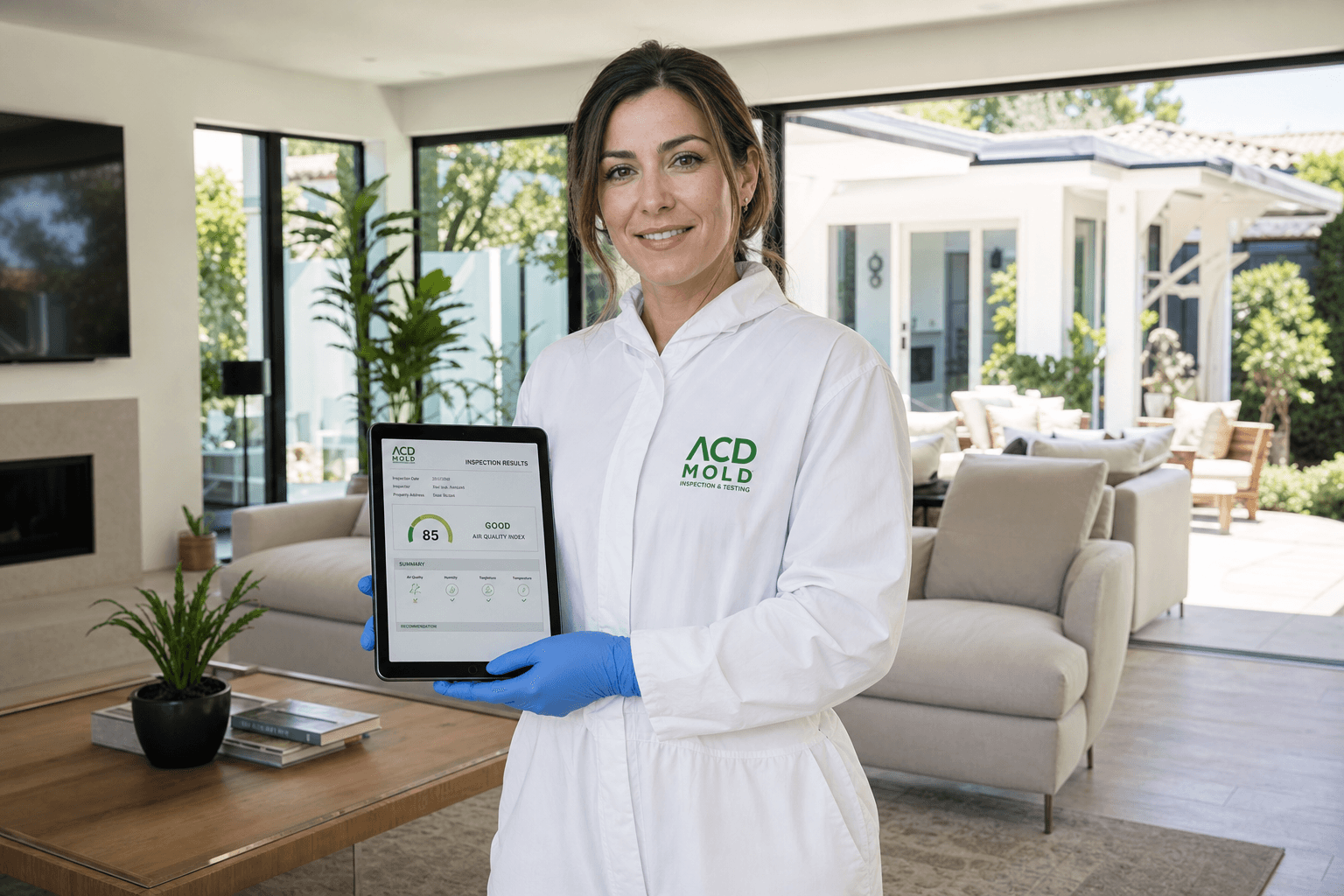
If you have spotted a stain on a Colfax Meadows ceiling, noticed a musty smell in a 1930s bungalow off Laurel Canyon, or want a clear picture before closing on a Studio City home, an inspection tells you what is actually happening behind the surface. ACD Mold is an independent inspection and testing company based in Encino, and our inspectors travel to you anywhere in the 91604 area. Because we only diagnose and verify, and never sell the removal work, our findings are not shaped by an incentive to tear out drywall. This page explains what a Studio City mold inspection covers, what it costs, and when adding lab testing is actually worth it.
What a Studio City mold inspection covers
A mold inspection is a non-invasive assessment of where moisture is collecting in your home and whether conditions favor mold growth. An inspector walks the property, documents any visible growth or water staining, and uses tools to trace the moisture that is usually the root cause. Nothing is cut open or demolished during a standard inspection.
It helps to be clear about the instruments. A thermal camera does not see mold through a wall; it detects temperature differences that often accompany trapped moisture, while a moisture meter measures a material's moisture content. Together they point an experienced inspector toward the source of a problem, but confirming active mold behind a surface still needs visible evidence or, in some cases, sampling.
- A thermal (infrared) camera to flag temperature differentials that can indicate moisture behind walls, ceilings, or under flooring
- A pin or pinless moisture meter to measure moisture content in drywall, plaster, framing, and subfloor
- A visual survey of common failure points: under sinks, around showers and tubs, behind toilets, at window frames, in attics, and in accessible crawl spaces
- A written report with photos, moisture readings, the suspected source, and recommendations, delivered in 24 to 48 hours
Why moisture hides in Studio City homes
Studio City sits in the inland San Fernando Valley, where hot, dry summers can mask moisture problems that surface as a slow stain or a seasonal musty smell rather than obvious flooding. A few patterns are common to the housing here.
None of this is unique to a single address, and we do not claim proprietary data about any street or ZIP. These are general, widely understood characteristics of the area's climate and housing stock, useful for knowing where to look rather than a prediction about your home.
- Lots closer to the Los Angeles River can carry extra ground and ambient humidity, which raises the moisture load on crawl spaces and lower walls.
- The studio-era bungalows that give neighborhoods like Laurel Terrace their character often date to the 1930s, with original plumbing and plaster-over-lath walls that hold and hide water differently than modern drywall.
- Studio City's many newer luxury rebuilds carry a different risk: remodels that tighten a house for energy efficiency can trap water vapor, and condensation can appear where new materials meet old framing or where ventilation was not fully reworked.
What to expect at the appointment
A typical single-family inspection takes roughly one to two hours, depending on the size of the home and how many areas of concern there are. You do not need to prepare much; clearing access to under-sink cabinets, closets against exterior walls, the attic hatch, and any crawl-space access helps the inspector cover more ground.
The inspector walks the property with you where possible, points out findings in real time, and explains what the moisture readings mean. If visible mold is present, expect a frank conversation: both the EPA and the California Department of Public Health advise that visible mold should be removed and the moisture source corrected regardless of species, so laboratory testing is often unnecessary to decide that cleanup is needed.
Afterward you receive a written report within 24 to 48 hours documenting the findings with photographs, moisture readings, the suspected source, and clear next steps.
Honest pricing and timing
A standard thermal and moisture inspection in Studio City runs $295 to $595. The range reflects size and complexity: a one-bedroom condo off Ventura Boulevard sits at the lower end, while a multi-story hillside home with a crawl space and several areas of concern is toward the top.
If sampling makes sense, testing is an optional add-on, roughly $95 per surface (tape or swab) sample or $145 to $195 per air sample analyzed by an AIHA-accredited laboratory. We will tell you beforehand, or during the visit, whether sampling is likely to add anything useful so you are not paying for data you do not need.
Reports are delivered in 24 to 48 hours. There is no storefront in Studio City; ACD is a service-area business based in Encino, and inspectors come to you.
When testing helps, and when it doesn't
Testing is frequently oversold. The honest guidance from federal and state authorities is that if you can already see mold, sampling usually is not necessary to justify cleaning it up. There are no EPA or federal numeric limits for airborne mold or spores to pass or fail against, and no health-based spore threshold from California public health agencies.
What testing does is characterize the sample taken, at that spot and that moment, and compare indoor spore counts against an outdoor baseline taken the same day. Air sampling draws air through a cassette, such as an Air-O-Cell, at about 15 liters per minute, and the lab counts and identifies the spores. That is genuinely useful in specific situations:
It is just as important to know what testing cannot do: it does not diagnose illness, and it cannot certify a building safe or mold-free. On black mold specifically, the CDC notes that a causal link between Stachybotrys and serious illness in otherwise-healthy people has not been established, and that any indoor mold should be removed regardless of species. The goal is to fix the moisture and remove the growth, not to chase a scary-sounding name.
- You smell or suspect mold but cannot see any, and want to know whether spores are elevated.
- You need an objective, documented baseline before or after a real-estate transaction or a dispute.
- Someone in the home has asthma, a mold allergy, or a weakened immune system and may react more strongly, and you want information to share with a physician.
- You need independent post-remediation clearance to confirm a cleanup actually worked.
If removal is needed: licensed partners and independent clearance
ACD Mold performs inspection, laboratory testing, and independent clearance. We do not perform the physical removal ourselves. When remediation is warranted we can coordinate licensed, insured remediation crews, or you are free to use your own contractor. Either way, the party diagnosing and verifying the work is not the party paid to tear things out.
That separation is deliberate: our findings are not driven by an incentive to maximize demolition, and clearance stays genuinely independent. California does not issue a mold-specific contractor license; remediation is performed under a standard CSLB contractor license, commonly a B general or a C-61/D-64 limited specialty classification, held by the crew doing the work.
Clearance is the final check. After a cleanup we re-inspect and, where appropriate, re-sample. A passing clearance means no visible mold growth remains and indoor spore counts are at or below the outdoor baseline, objective confirmation that both the work and the underlying moisture problem were resolved.
Your next step
If you have visible mold, a musty smell, a recent leak, or a transaction that calls for documentation, a scheduled inspection is the most direct way to find out what is really going on. Call ACD Mold at (424) 352-7039 and describe what you are seeing; we can often tell you on the phone whether an inspection, testing, or simply correcting an obvious moisture source is the right first move. Studio City inspections are by appointment, with the written report following within 24 to 48 hours.
Authoritative Sources Referenced
ACD Mold's inspection and testing protocols — and the remediation partners we coordinate — follow the published guidance of the recognized authorities below. Click through to verify any statement on this page:
- U.S. Environmental Protection Agency — Mold
- Centers for Disease Control and Prevention — Mold
- IICRC S520 Standard for Professional Mold Remediation
- American Industrial Hygiene Association (AIHA) Laboratory Accreditation Programs
- California Department of Public Health — Indoor Air Quality
- OSHA — Mold Health Hazards