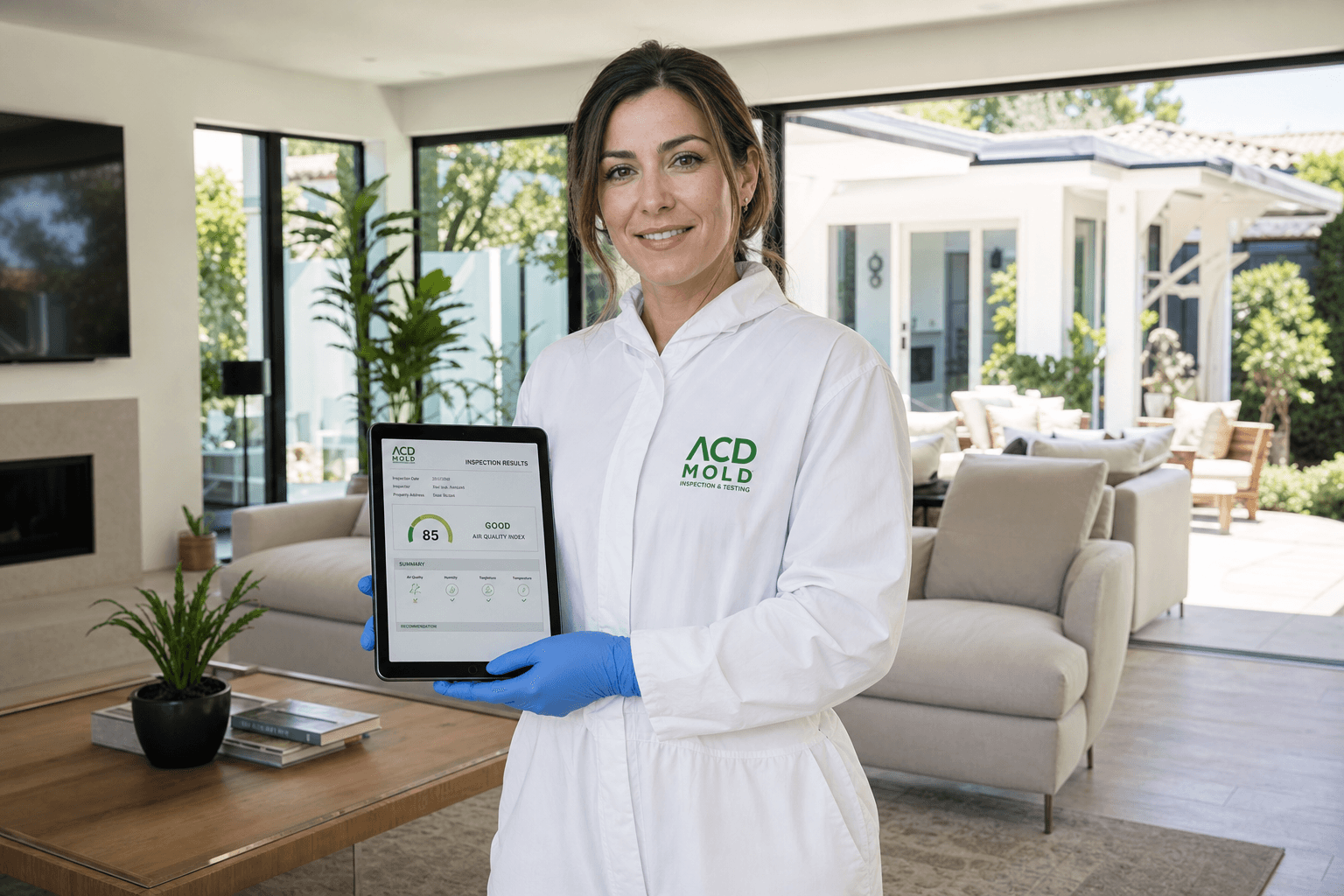
Pasadena sits where the San Gabriel foothills meet the valley floor, and a lot of its character comes from housing that predates modern moisture control: original-plaster Craftsman bungalows in neighborhoods like Bungalow Heaven, Spanish-revival homes with stucco and tile, and older foundations with basements or French drains near the San Rafael Hills. ACD Mold provides independent mold inspection, AIHA-accredited lab testing, and post-remediation clearance across Pasadena and the wider San Gabriel Valley. We diagnose and verify; we do not sell the removal work itself, which keeps our findings free of any pressure to overstate a problem. If you have noticed a musty smell, staining after a winter storm, or an old leak you were never sure got fully dry, an inspection tells you what is actually there.
What a mold inspection covers in a Pasadena home
A standard inspection is non-invasive and visual-first. An inspector walks the property looking for the conditions that let mold grow: current or past water intrusion, elevated surface moisture, and organic materials that stay damp long enough to support growth. We pair that walkthrough with instruments rather than guesswork.
Two tools do most of the work. A thermal camera flags temperature differentials on walls, ceilings, and floors that often correspond to trapped moisture, and a moisture meter then measures the material directly to confirm or rule it out. It is worth being clear about their limits: a thermal camera does not see mold through a wall, and a moisture meter reads moisture, not spores. They tell us where to look closely, not what the answer is.
- Roofline, attic, and ceilings for signs of past roof or flashing leaks
- Bathrooms, kitchens, and laundry areas where plumbing and humidity concentrate
- Crawlspaces, basements, and the base of walls near foundations
- Windows and original plaster, which show water history in older homes
- HVAC equipment and condensate drainage
- Exterior grade and drainage directing water toward or away from the structure
Why foothill homes here see moisture problems
Pasadena's position against the foothills shapes how water moves. Foothill drainage tends to direct surface and subsurface water toward foundations, and the intense winter rain events that roll through the San Gabriel Valley can overwhelm older roofing and drainage systems that were never designed for today's storm intensity. Homes built in the early twentieth century often rely on original plaster, older downspout routing, and in some cases aging French drains or basements that were state of the art a century ago.
None of this means a Pasadena home is destined for a mold problem. It means the common entry points are predictable: a roof valley that sheds water behind a parapet, a planter that slopes toward the house, a crawlspace vent that sits where runoff collects. A good inspection follows the water first and the staining second.
Homes in and around the areas affected by the January 2025 Eaton Fire are a separate case. Where structures took on water from suppression efforts or were left open to weather during cleanup and rebuilding, moisture can be trapped in materials well after the visible soot is gone. An inspection there focuses on whether assemblies dried properly, not on assumptions.
What to expect at the appointment
A typical inspection of a single-family home takes one to two hours depending on size, access, and how many problem areas need attention. The inspector will want access to the spaces that matter: under sinks, the attic hatch, the crawlspace or basement, the water heater, and any room tied to a past leak or odor.
You are welcome to walk along. We would rather explain what the thermal camera is actually showing in real time than hand you a report full of jargon later. If there is no sign of active moisture and no visible growth, we will tell you that plainly rather than invent a reason to test. If we do find something, you will know before we leave.
Honest pricing and timing
A thermal and moisture inspection runs $295 to $595, with the range driven mainly by home size and how many areas need close attention. If laboratory testing is warranted, a surface or tape-lift sample adds about $95 per surface, and an air sample runs $145 to $195 each; the right number of samples depends on what the inspection finds, not a fixed package.
Your written report, including instrument findings and any lab results, is delivered within 24 to 48 hours. We quote the inspection fee up front, and because we are not the party paid to remove anything, there is no built-in reason to recommend more sampling than the situation calls for.
When testing helps and when it does not
Testing is useful in specific situations, and skipping it is often the right call. Following EPA guidance, if mold is already visible you usually do not need to sample to confirm it is there; the practical question becomes fixing the moisture source and removing the growth. The California Department of Public Health takes a parallel view: it recommends promptly removing all visible mold and correcting the moisture problem, and it does not use a size threshold or advise routine measuring.
Where sampling earns its place is when there is a musty odor but no visible source, when you need to compare what is in the air against an outdoor baseline, or when you want documentation before a sale or after remediation. It helps to know the limits: air and surface sampling characterize the sample taken at that time and place; they do not diagnose illness and do not certify a building safe.
On species: the CDC has not established that so-called black mold or Stachybotrys causes serious illness in otherwise-healthy people, and black mold is not a distinct medical diagnosis. The guidance is the same regardless of color or species, any indoor mold should be removed and the moisture fixed. People with asthma, mold allergies, or a compromised immune system may react more strongly, which is a reason to act, not to panic.
How removal and clearance are handled
When removal is needed, ACD does not perform it, and that separation is deliberate. The party diagnosing and verifying the work should not be the party paid to remove it. We coordinate licensed, insured remediation partner crews, or you are free to bring your own contractor. In California there is no state mold-specific license; remediation is performed under a CSLB contractor license, commonly a B or C-61/D-64 classification held by the crew doing the physical work.
After the work is done, we come back for independent clearance. Clearance means the previously affected area shows no visible growth and that post-work spore counts are at or below the outdoor baseline. Because we do not have a financial stake in the removal, that verification is genuinely independent, which is the whole point.
A clear next step
If you are weighing whether you even need an inspection, start with the moisture question: has this home had a leak, a roof issue, a drainage problem, or a lingering musty smell? If yes, an inspection is the low-cost way to find out what is really going on before it becomes expensive. If no, a short conversation may save you the visit entirely.
To schedule an inspection anywhere in Pasadena, call ACD Mold at (424) 352-7039. We will talk through what you are seeing and set a time that works.
Authoritative Sources Referenced
ACD Mold's inspection and testing protocols — and the remediation partners we coordinate — follow the published guidance of the recognized authorities below. Click through to verify any statement on this page:
- U.S. Environmental Protection Agency — Mold
- Centers for Disease Control and Prevention — Mold
- IICRC S520 Standard for Professional Mold Remediation
- American Industrial Hygiene Association (AIHA) Laboratory Accreditation Programs
- California Department of Public Health — Indoor Air Quality
- OSHA — Mold Health Hazards