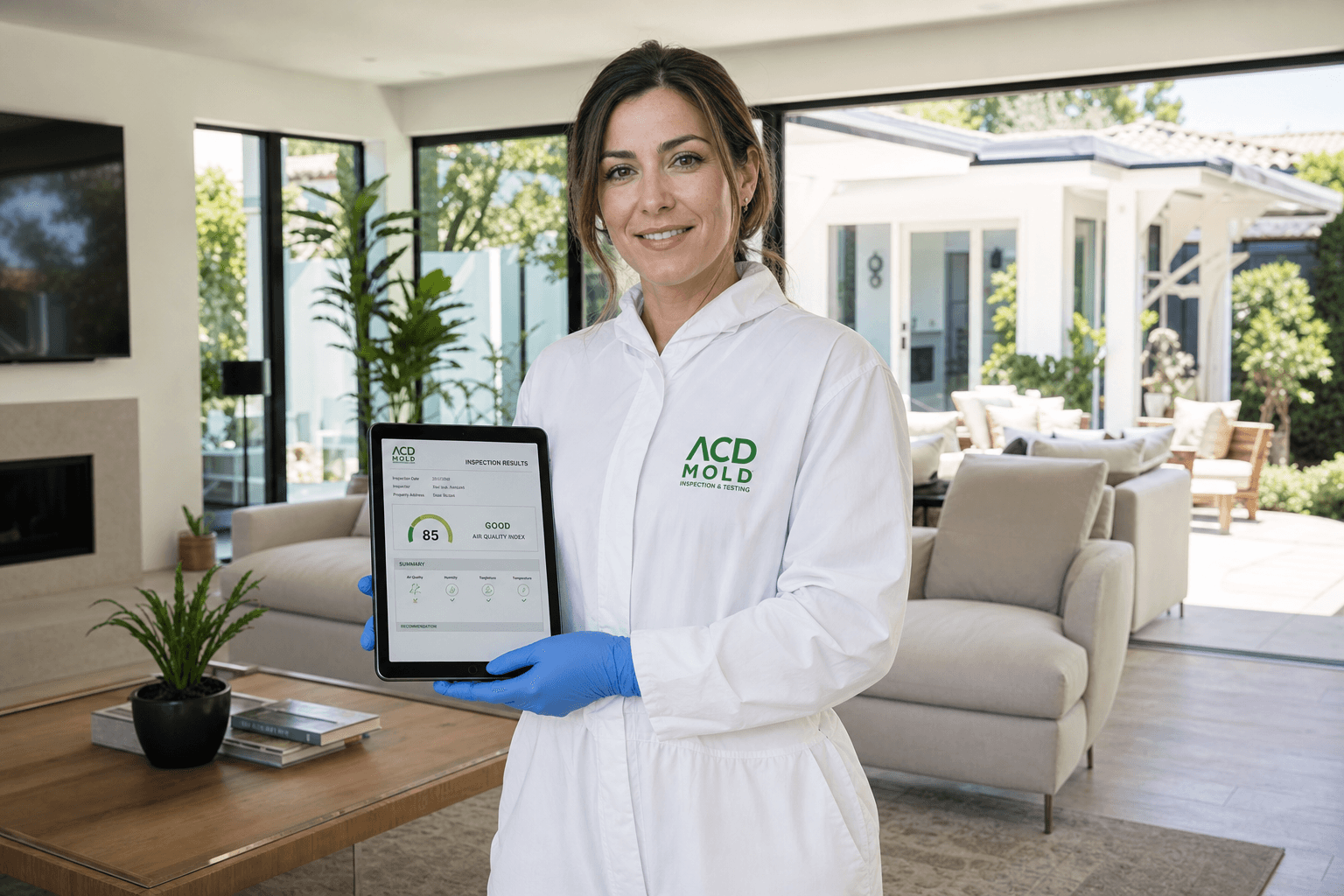
ACD Mold provides independent mold inspection throughout Pacific Palisades, from the Riviera and Marquez Knolls to the Palisades Highlands and the canyons above Sunset. We are an inspection, laboratory testing, and clearance company only. We diagnose and verify; we do not sell removal, so the person assessing your home has no financial stake in finding a bigger problem. An inspector travels to you (we are a service-area business headquartered in Encino, not a storefront on PCH), reads the building with thermal imaging and moisture meters, and tells you plainly what is and isn't a concern. Call (424) 352-7039 to arrange a visit.
What a mold inspection here actually involves
A mold inspection is a diagnostic visit, not a cleaning service. The goal is to find where moisture is getting in or lingering, judge whether conditions favor mold, and document it so you can decide what to do. EPA notes that mold can begin establishing itself within 24 to 48 hours of water intrusion, so an inspection is as much about catching active moisture as confirming visible growth.
Be clear about what the tools do: a thermal camera and a moisture meter detect temperature and moisture differentials, not mold itself. They point the inspector to where to look more closely, sometimes through a small, pre-agreed borescope port.
- A walkthrough of your areas of concern plus common failure points: bathrooms, under-sink cabinets, window and door surrounds, roof-adjacent ceilings, crawl spaces, and attics
- Thermal (infrared) imaging to flag temperature differentials that often correspond to hidden moisture
- Pin and pinless moisture-meter readings on suspect surfaces
- A borescope look inside a wall cavity where a reading warrants it
- A written summary with photos, the likely moisture source, and practical next steps
Why Pacific Palisades homes raise specific moisture questions
Several things about this stretch of the Westside make moisture worth taking seriously, none of them unique to any one address. Coastal marine-layer humidity is common here, and morning fog and onshore air keep shaded walls, north elevations, and crawl spaces damp well into the day. The canyons and hillsides that define neighborhoods like the Highlands and the slopes above Sunset channel surface and subsurface drainage, so hillside and slide-zone moisture can migrate toward foundations and lower levels. Palisades housing also runs a wide range, from mid-century post-and-beam and ranch homes to newer construction, and older low-slope roofs, dated window details, and unconditioned crawl spaces each have characteristic weak points.
The January 2025 Palisades Fire affected this community directly. Homes being rebuilt, or standing near fire-damaged structures, can carry moisture conditions that are easy to overlook: water used in firefighting, assemblies left open to the weather, and the ordinary dampness of a construction site before a building is dried in and sealed. If you are in a rebuild or returning to a property that was exposed, an inspection can establish where things stand before walls are closed up. This is a practical checkpoint, not a cause for alarm.
What to expect at the appointment
A typical inspection of a single-family home takes one to two hours, depending on size, access, and how many areas are in question. The visit is non-invasive: the inspector works with surface readings and imaging, and only opens anything, such as a small borescope port, with your agreement beforehand. Clear access to sinks, the water heater, the attic hatch, and any area you're worried about helps.
If you've had a specific event, such as a roof leak after a storm, a slab leak, a supply-line failure, or a bathroom that never quite dries out, tell the inspector; knowing the history focuses the visit. You'll get a plain-language explanation on site and a written report afterward. If nothing of concern turns up, we'll say so. A clean inspection is a legitimate and common outcome, and we have no incentive to manufacture a problem.
When testing adds something, and when it doesn't
Lab testing is an optional add-on, not a default. EPA advises that when mold is already visible, sampling is usually unnecessary: you can see the problem, and the response is the same regardless of species. CDPH, the California Department of Public Health, takes a similar line, recommending that all visible mold simply be removed and the moisture source fixed, with no size threshold and no routine measuring.
Testing earns its place in narrower cases: a musty odor or a history of water damage with nothing visible, a wish to characterize the air relative to outdoors, or a transaction or dispute that calls for documentation. Air sampling draws a measured volume through a cassette (an Air-O-Cell runs at about 15 liters per minute) and is compared against an outdoor baseline taken the same day; surface sampling characterizes a specific spot. A sample describes the material or air at that place and time. It does not diagnose illness and cannot certify a building safe. There are no EPA or federal numerical limits for airborne mold or spores, and no health-based spore thresholds, so no lab result can declare a home healthy or hazardous on numbers alone.
On black mold specifically: CDC states that a causal link between Stachybotrys and serious illness in otherwise-healthy people has not been established, and that black mold is not a distinct diagnosis. Any indoor mold should be removed regardless of species. People with asthma, mold allergies, or weakened immune systems may react more strongly, which is a sensible reason to address growth promptly, not a reason to fear a particular color on a wall.
Honest pricing and timing
A standard thermal-and-moisture inspection in Pacific Palisades runs $295 to $595. A compact condo sits near the low end, while a large hillside home with multiple levels, a complex roofline, or difficult crawl-space access scopes higher. We confirm the figure for your property before booking. Sampling is priced per sample because the right number depends on your home, and many inspections need none. Lab turnaround is typically a few business days.
- Inspection (thermal + moisture, non-invasive): $295-$595
- Surface sample added to an inspection: about $95 per surface
- Air sample added to an inspection: $145-$195 per sample
If removal is needed: licensed partners and independent clearance
Here is where our structure matters. ACD Mold performs inspection, testing, and clearance. We do not perform the physical removal. When mold needs to be taken out, we coordinate licensed, insured remediation crews, or you're free to use a contractor of your own. Either way, the people removing the mold are not the people who diagnosed it or who will verify the result. California does not issue a mold-specific contractor license; remediation is performed under a standard CSLB contractor license, commonly a B general or a C-61/D-64 classification, held by the crew doing the work. We don't claim a mold license, because no such thing exists.
After removal, we return to perform an independent clearance inspection, which for many jobs includes air sampling. Clearance means spore counts at or below the outdoor baseline, no remaining visible growth, and the moisture source addressed. Because we're paid to verify rather than to remove, that verification isn't a formality; it's the actual check on whether the work was done. For a small, isolated patch, EPA's general guidance is roughly under 10 square feet, a homeowner taking normal precautions can often clean it themselves after fixing the moisture. That figure is EPA's rule of thumb for do-it-yourself versus professional removal; it is not a California legal trigger and not a CDPH rule. When in doubt, an inspection will tell you which situation you're in.
A clear next step
If you've seen or smelled something, had a leak or a storm event, or you're dealing with a rebuild after the fire, the most useful first move is an independent look, before you commit to any removal work or spend money chasing a problem that may not be there. Call ACD Mold at (424) 352-7039 to schedule an inspection anywhere in Pacific Palisades and the 90272 area. We'll tell you what we find, whether or not it leads to more work for anyone.
Authoritative Sources Referenced
ACD Mold's inspection and testing protocols — and the remediation partners we coordinate — follow the published guidance of the recognized authorities below. Click through to verify any statement on this page:
- U.S. Environmental Protection Agency — Mold
- Centers for Disease Control and Prevention — Mold
- IICRC S520 Standard for Professional Mold Remediation
- American Industrial Hygiene Association (AIHA) Laboratory Accreditation Programs
- California Department of Public Health — Indoor Air Quality
- OSHA — Mold Health Hazards