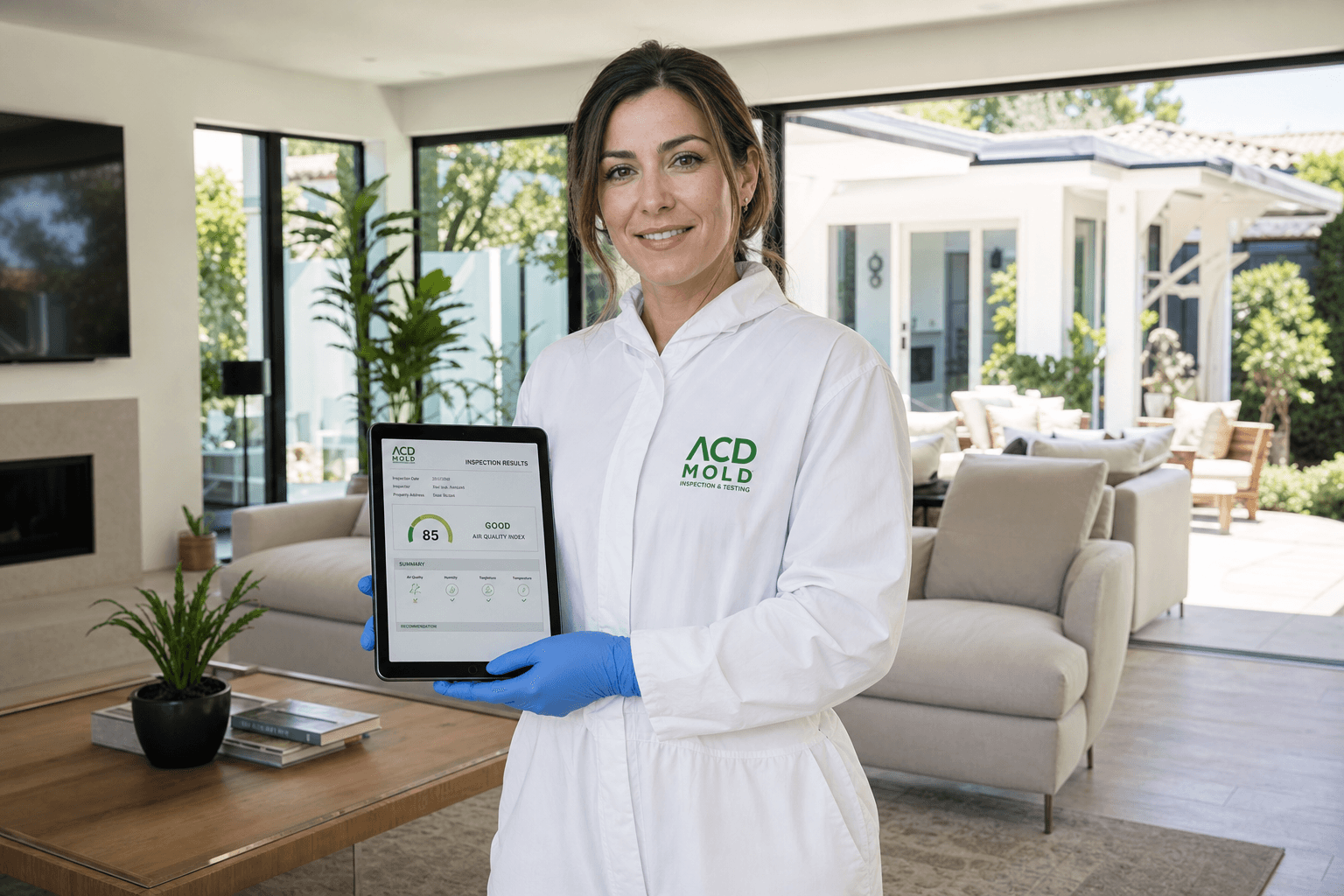
Los Angeles packs nearly every kind of California building into one 469-square-mile city: 1920s Spanish and Craftsman bungalows in Hancock Park, Hollywood, and Highland Park; hillside homes above Brentwood, Bel Air, and Mt. Washington; postwar tract houses; and Downtown high-rise condos. A mold inspection from ACD Mold is an independent, non-invasive look at where moisture is actually getting into your specific building and whether hidden growth has followed. We inspect, we test through an AIHA-accredited lab, and we provide independent clearance on remediation work. We do not sell you the removal job itself, so the findings you receive are a diagnosis, not a pitch for work we profit from.
What a mold inspection covers in Los Angeles
A standard inspection is a methodical walkthrough paired with a moisture survey. We start with the visible: staining, warping, efflorescence, musty odor, and the areas you've already noticed. Then we trace the water. Mold is a moisture problem first, so the goal is to find the intrusion source, map how far it has traveled, and judge whether sampling will actually tell you anything you don't already know.
We use FLIR thermal imaging, pin and pinless moisture meters, hygrometers, and borescopes. It's worth being precise about what these tools do: thermal cameras and moisture meters read temperature and moisture differentials behind finishes. They help us decide where to look more closely; they do not "see" mold through a wall. A borescope lets us check inside a cavity through a small, pre-agreed access point rather than opening up drywall.
The inspection is non-invasive by default. If the only way to confirm suspected hidden growth is a small exploratory opening, we discuss that with you first. You leave with a written report describing what we found, the likely moisture source, and a clear recommendation on whether testing or removal is warranted.
The local factors that make an inspection worthwhile here
Because the housing stock is so varied, the relevant risks change by neighborhood. On the Westside, in areas like Mar Vista, Westwood, and Brentwood, the June-gloom marine layer brings weeks of elevated humidity, and north-facing walls and crawl spaces can stay damp for hours each morning. That steady dampness matters more for slow, chronic moisture than for any single dramatic leak.
Hillside properties above Brentwood, the Hollywood Hills, and Mt. Washington face a different issue: slope drainage. Surface and subsurface water moves downhill toward foundations and crawl-space vents, so the moisture often shows up low in the structure rather than at the roofline.
Pre-1960 homes across Hollywood, Hancock Park, and Highland Park frequently still have aging cast-iron drain lines and galvanized supply piping near the end of their service life, which produce the slow, concealed leaks that feed hidden growth. Downtown high-rise and converted-loft condos add shared walls and shared mechanical systems, where a neighboring unit's leak or a common condensate line can become your problem. None of this is a reason to assume you have mold; it's the reason an inspection targets the right places instead of guessing.
What to expect at the appointment
Plan on roughly an hour for a typical single-family home, longer for larger or multi-level properties. We'll ask about the building's history: past leaks, recent rain or plumbing events, renovation work, and where you've noticed odor or symptoms. That context narrows the search considerably.
From there we run the visual and instrument survey room by room, paying attention to the areas the building's age and layout flag as likely. We walk you through what we're seeing as we go, and we'll tell you plainly when something looks like a non-issue. If sampling makes sense, we explain what each sample can and can't answer before collecting anything.
Your written report typically arrives within 24 to 48 hours. If we collect lab samples, those results generally take 3 to 5 business days and are incorporated into the findings.
Honest pricing and timing
A standard residential inspection runs $295 to $595 depending on the size and scope of the property. A compact condo sits at the lower end; a large hillside home with multiple levels and a crawl space sits toward the top.
Lab testing is optional and priced separately: about $95 per surface (tape or swab) sample, or $145 to $195 per air sample, depending on the analysis. Air sampling is run on cassettes drawn at roughly 15 liters per minute and compared against an outdoor baseline taken the same day.
We recommend testing only when it will change a decision. Often it won't, and we'll say so rather than add samples to an invoice.
- Standard residential inspection: $295-$595 by size and scope
- Surface sample (lab): ~$95 each
- Air sample (lab): $145-$195 each
- Written report: typically 24-48 hours
- Lab results: typically 3-5 business days
When testing is and isn't needed
If you can already see mold, the EPA notes that sampling is usually unnecessary; you already know you have a problem and the response is the same regardless of what a lab names it. The California Department of Public Health goes further and recommends promptly removing all visible mold and fixing the moisture source, without any size threshold and without routine measuring. There are no EPA or federal limits for airborne mold or spores, and no health-based spore thresholds to pass or fail.
Testing earns its place in specific situations: confirming suspected hidden growth you can't see, establishing an indoor-versus-outdoor baseline before and after work, or documenting conditions for a real-estate or insurance question. It's important to understand the limits of any result. A sample characterizes that one spot at that one moment and compares it to an outdoor baseline. It does not diagnose illness and it cannot certify a building "safe."
On "black mold": the CDC states that a causal link between Stachybotrys and serious illness in otherwise-healthy people has not been established, and that "black mold" is not a distinct diagnosis. Any indoor mold should be removed regardless of species, and people with asthma, mold allergies, or weakened immune systems may react more strongly. You may also have read about the 10-square-foot figure. That is EPA's general guidance for when a homeowner can reasonably clean a small patch themselves versus calling a professional; it is not a CDPH rule and not a legal trigger.
How removal and clearance are handled
When removal is needed, this is where our structure matters. ACD does not perform the physical remediation. Instead, we coordinate licensed, insured remediation partner crews, or you're free to use your own contractor. California has no state mold-specific license; remediation is performed under a CSLB contractor license, commonly a B general or a C-61/D-64 specialty license held by the crew doing the work.
After the removal is complete, we return to independently verify it. Because the party checking the work is not the party that was paid to do it, that verification carries weight. Clearance means the work area shows no visible growth and airborne spore counts are at or below the outdoor baseline taken that day.
This separation is deliberate. The inspection and the clearance are the parts we stand behind; the removal belongs to a qualified crew whose work we hold to an independent standard.
Scheduling an inspection
ACD Mold is a service-area business headquartered in Encino, and our inspectors travel to you throughout Greater Los Angeles, from Downtown and Silver Lake to the Westside and the hillside neighborhoods. There is no storefront to visit; we come to the property.
If you've had a leak, noticed a musty smell, or simply want an independent read before a purchase or repair, call (424) 352-7039. We'll ask a few questions, tell you honestly whether an inspection is the right next step, and schedule a visit.
Authoritative Sources Referenced
ACD Mold's inspection and testing protocols — and the remediation partners we coordinate — follow the published guidance of the recognized authorities below. Click through to verify any statement on this page:
- U.S. Environmental Protection Agency — Mold
- Centers for Disease Control and Prevention — Mold
- IICRC S520 Standard for Professional Mold Remediation
- American Industrial Hygiene Association (AIHA) Laboratory Accreditation Programs
- California Department of Public Health — Indoor Air Quality
- OSHA — Mold Health Hazards