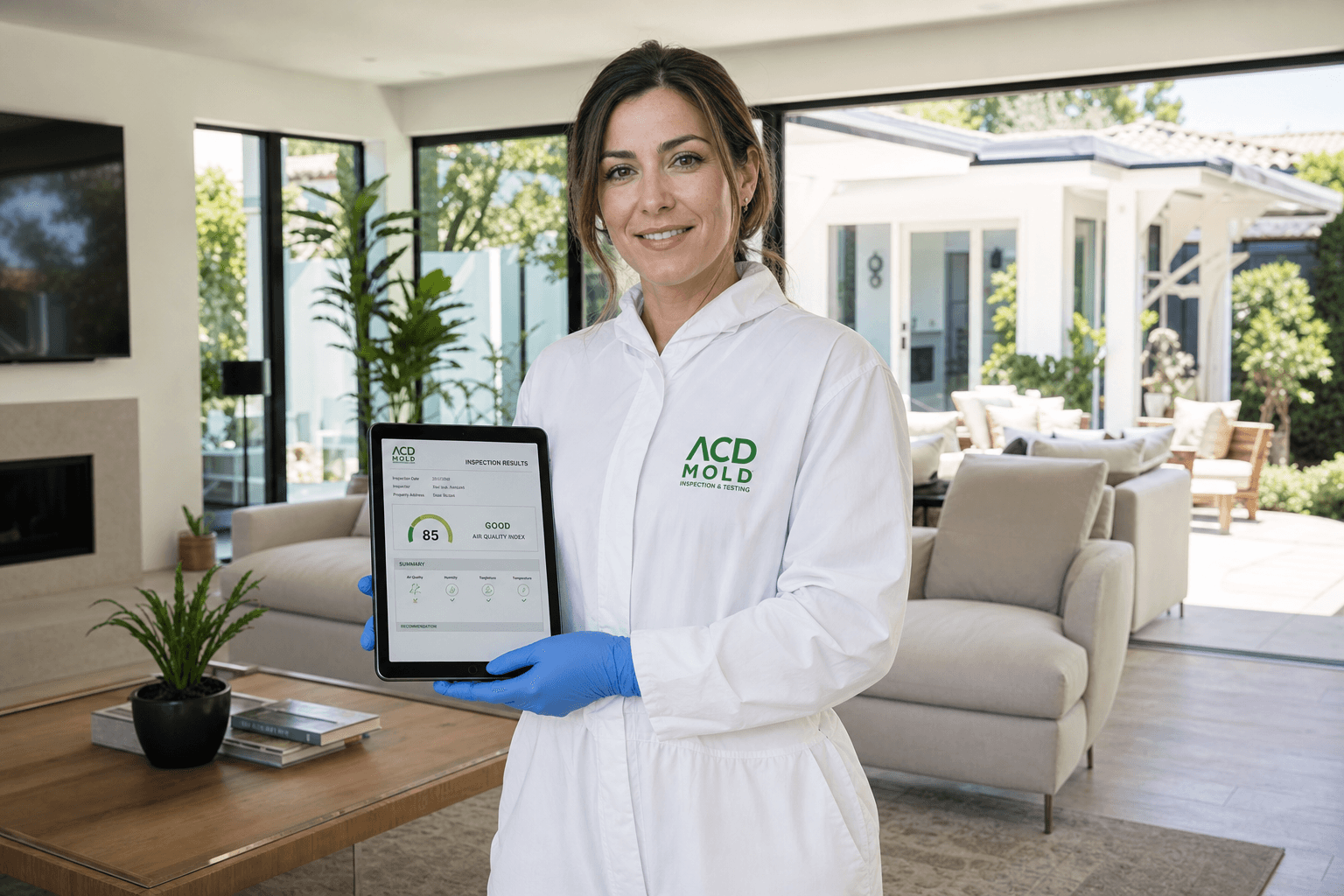
ACD Mold provides independent mold inspection for homes and buildings throughout Long Beach, from the beach cottages of Belmont Shore and Naples to the Craftsman blocks of Bixby Knolls and the condos downtown. We are a diagnostic and testing company: our job is to find where moisture is getting in, map how far any growth has spread, and give you a clear, unbiased picture of the problem. Because we do not sell removal work, the findings you receive are not shaped by an incentive to tear out more than necessary.
What a mold inspection in Long Beach actually covers
A mold inspection is a structured assessment of where moisture is present and whether conditions support mold growth. Our inspectors walk the property, document visible staining or growth, and use instruments to look for the hidden moisture that usually drives a mold problem. The goal is to answer three practical questions: is there a moisture source, how far does it extend, and what would it take to correct it.
In a coastal city like Long Beach, that often means close attention to building envelopes exposed to salt air and wind-driven rain, to crawl spaces and ground-floor framing near the shoreline, and to mechanical systems that create condensation. We look for the cause behind a stain, not just the stain itself, because mold cleaned without fixing the moisture source tends to return.
Why Long Beach's coast and housing stock raise moisture risk
Long Beach sits on the coast, and several widely understood local conditions make moisture worth taking seriously. Coastal salt air and marine-layer humidity keep outdoor moisture levels elevated for much of the year, and a high water table near the shoreline can push dampness up into crawl spaces and slab-adjacent framing. These are general facts about the area, not measurements of your specific home.
The housing is also varied, and different building types fail in different ways. Historic Craftsman homes and older beach cottages often retain original plaster and wood framing that hold and show moisture differently than modern drywall. Waterfront properties near the Naples canals can have crawl spaces that stay humid from their proximity to standing water. Condos introduce a different pattern: HVAC systems and poorly drained condensate lines can create persistent dampness inside wall and ceiling cavities far from any obvious leak.
The EPA notes mold can begin growing within 24 to 48 hours of water intrusion, so the speed of response to a leak often matters more than the age of the building.
What to expect during the appointment
The inspection is non-invasive. We do not cut into walls or remove finishes as a matter of course; instead we use instruments that read conditions through surfaces and, where there is an accessible opening, a borescope to view inside a cavity. A typical visit includes:
- A visual survey of the interior, accessible exterior, and any crawl space or attic, documenting staining, past water marks, and areas of concern
- Thermal imaging with a FLIR camera to locate temperature differentials that can indicate trapped moisture
- Moisture-meter readings on suspect walls, floors, and framing to confirm whether a cool spot is actually wet
- Borescope inspection of wall or ceiling cavities where a small existing access point allows it
- A plain-language review of what was found and what, if anything, warrants further action
Honest pricing and timing
A standard Long Beach mold inspection ranges from $295 to $595, depending on the size of the property and the number of areas to assess. That covers the thermal, moisture, and borescope work and a review of the findings with you.
Laboratory testing is a separate, optional add-on. Surface or tape-lift samples run about $95 per surface, and air samples are $145 to $195 per sample. Air samples are collected on Air-O-Cell cassettes at roughly 15 liters per minute and read by an accredited laboratory. We will only recommend testing when it answers a question the inspection itself cannot, and we will tell you plainly when it is not needed. Lab results typically take a few business days to return.
When testing helps, and when the inspection is enough
Testing is useful in specific situations, but it is not a default. The EPA's position is that when mold is already visible, sampling is usually unnecessary: you can see the problem, so the priority is removing the growth and fixing the moisture. There are no EPA or federal limits for airborne mold or spore counts, and no health-based threshold a lab result can be measured against, so a number on a report does not tell you whether a building is safe to occupy.
Where testing earns its place is in characterizing a sample taken at one time and place, comparing an indoor air sample against an outdoor baseline, confirming whether a hidden cavity is affected, or documenting conditions before and after work. It does not diagnose illness and cannot certify a building 'safe.' On health, the CDC notes that a causal link between so-called 'black mold' or Stachybotrys and serious illness in otherwise-healthy people has not been established. Any indoor mold should be removed regardless of species, and people with asthma, mold allergies, or weakened immune systems may react more strongly.
If removal is needed: licensed partners and independent clearance
ACD Mold performs inspection, lab testing, and independent clearance verification. We do not perform the physical removal ourselves. When removal is warranted, we can coordinate licensed, insured remediation partner crews, or you are welcome to hire your own contractor. California does not issue a mold-specific license; remediation is carried out under a California contractors' license (commonly a B, or a C-61/D-64 classification) held by that crew.
Keeping diagnosis and verification separate from removal is deliberate: the party checking the work is not the party paid to perform it, which removes the conflict of interest that exists when one company both decides how much to tear out and profits from doing it. After remediation, we can return to perform an independent clearance, meaning spore counts are at or below the outdoor baseline with no remaining visible growth.
California's Department of Public Health recommends promptly removing all visible mold and fixing the moisture source, and uses no size threshold. The EPA's separate guidance that a patch under roughly 10 square feet can often be handled by a homeowner taking precautions is DIY-versus-professional advice, not a legal trigger or a California rule.
Booking an inspection
If you have a leak, a musty smell, visible staining, or simply want a clear read on a property before buying or after a water event, an inspection is a sensible first step. ACD Mold is based in Encino and serves Long Beach as a traveling service-area business, so an inspector comes to you; there is no storefront to visit. Call (424) 352-7039 to describe the situation and schedule a visit, and we will tell you honestly whether an inspection, testing, or neither is the right call.
Authoritative Sources Referenced
ACD Mold's inspection and testing protocols — and the remediation partners we coordinate — follow the published guidance of the recognized authorities below. Click through to verify any statement on this page:
- U.S. Environmental Protection Agency — Mold
- Centers for Disease Control and Prevention — Mold
- IICRC S520 Standard for Professional Mold Remediation
- American Industrial Hygiene Association (AIHA) Laboratory Accreditation Programs
- California Department of Public Health — Indoor Air Quality
- OSHA — Mold Health Hazards