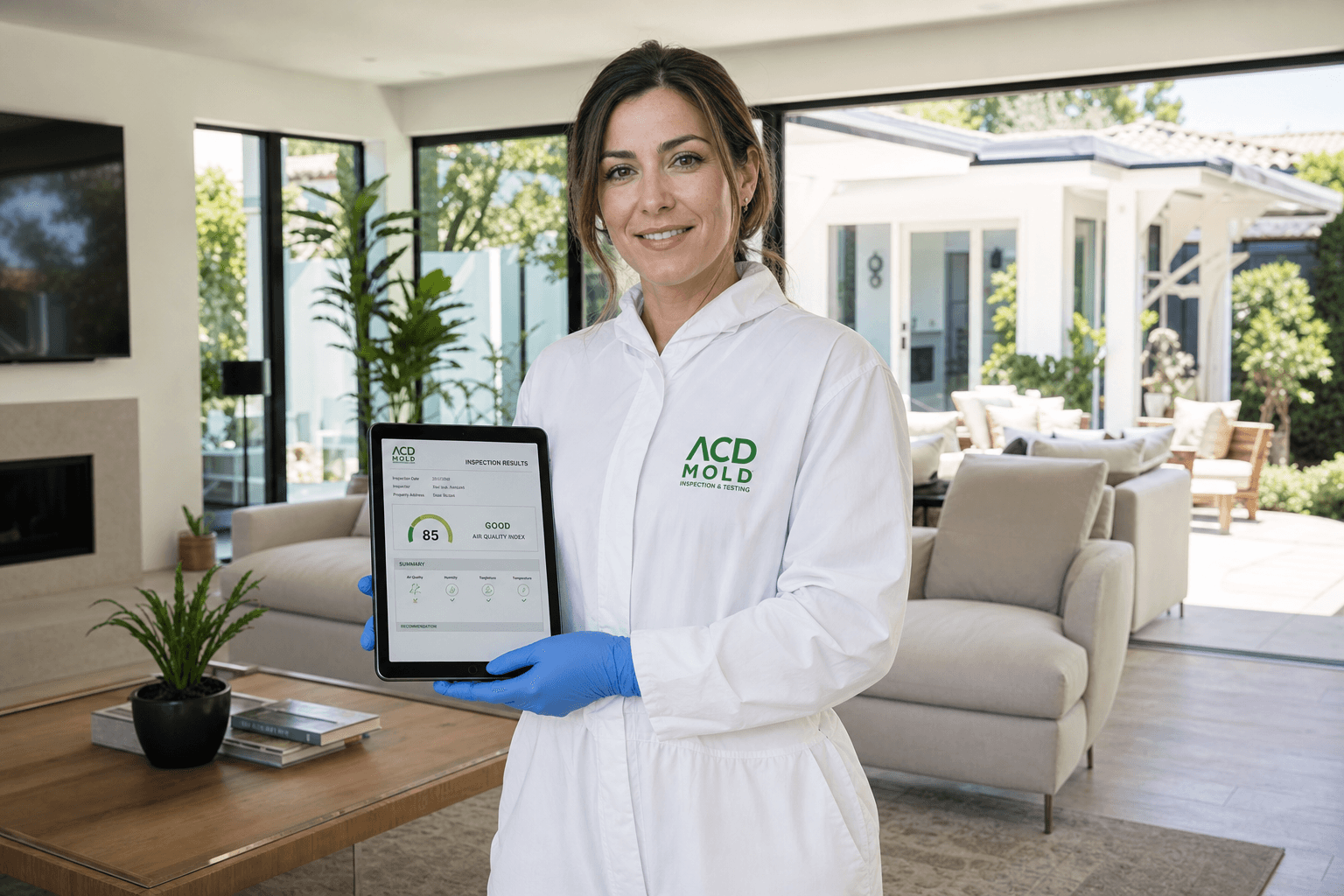
ACD Mold is an independent mold inspection and testing company serving Glendale and the surrounding Verdugo foothills. An inspector travels to your home or building, maps moisture with thermal imaging and meters, and gives you a clear read on whether you have a mold problem, where the water is coming from, and what (if anything) needs to happen next. We diagnose and verify work; we do not perform the removal ourselves, which keeps our assessment free of any incentive to over-recommend. Call (424) 352-7039 to schedule.
What a mold inspection covers in Glendale
A mold inspection is a structured visual and moisture assessment of the areas you are concerned about. The goal is to confirm whether active moisture or mold growth is present, trace it back to its source, and document the finding so you can make a decision. Glendale homes range from century-old hillside houses in Verdugo Woodlands to downtown condo towers, so the inspection is shaped around the building in front of us rather than a fixed checklist. A typical visit covers the reported problem area, adjacent assemblies, and any accessible attic, crawlspace, or under-sink cabinetry, looking for the conditions that let mold grow: standing water, chronic dampness, condensation, and poor drainage or ventilation. Laboratory testing can be added where useful, but it is an option rather than a default.
- Visual assessment of the areas of concern and adjacent assemblies
- Thermal imaging to find temperature differentials that often mark hidden moisture
- Moisture-meter readings on walls, ceilings, subfloors, and cabinetry
- A review of the likely moisture source so the underlying cause can be fixed
- A plain-language summary of findings and recommended next steps
Why Glendale's foothills and housing stock matter
Glendale sits against the Verdugo Mountains and San Rafael Hills, and that geography drives many of the moisture issues we are asked to look at. Hillside Spanish-revival homes in neighborhoods like Adams Hill and Verdugo Woodlands sit on slopes where water moves downhill through soil and can seep against foundations and lower-level walls, especially after a wet winter. Many of these older homes also retain portions of their original plumbing, which can leak slowly before anyone notices a stain.
Elsewhere the pattern changes: mid-century duplexes often have low-slope roofs and aging supply lines, while the downtown high-rise condos commonly see HVAC-related condensation at air handlers and ductwork. None of this is proprietary data on our part; it is the well-known building physics of a foothill city with a wide mix of housing eras. The practical point is that the smartest place to put the moisture meter differs between a 1925 hillside bungalow and a 2008 condo, and the inspection adapts accordingly.
What to expect at the appointment
The inspector arrives at the scheduled time, confirms what prompted the call, and asks a few questions about the history of any leaks, past water damage, or recent repairs. That context matters, because a stain from a roof leak that was fixed three years ago calls for a very different conclusion than a baseboard that is wet today.
The moisture survey itself is non-invasive. Thermal cameras and moisture meters read temperature and moisture differentials at the surface; it is worth being clear that these instruments do not see mold through walls and cannot by themselves confirm what is behind a finished surface. They point us to the areas worth a closer look. If a reading strongly suggests a concealed problem, we will discuss whether a small inspection opening or follow-up testing makes sense before anyone starts cutting into walls. Most residential visits take roughly one to two hours depending on the size of the home and how many areas are involved.
Honest pricing and timing
A standard thermal-and-moisture inspection runs $295 to $595, with the range driven mainly by the size of the property and how many separate areas need to be assessed. A single condo or a focused one-room concern sits at the lower end; a larger multi-level hillside home with an attic and crawlspace sits higher.
Laboratory testing, when you choose to add it, is priced separately: roughly $95 per surface sample or $145 to $195 per air sample, plus the accredited-lab analysis. You will know which samples are being recommended, and why, before anything is collected. We can usually schedule an inspection within a few days, and you receive a written summary of findings after the visit; when samples are sent to the lab, results typically follow within a few business days.
When testing helps and when it does not
Testing is genuinely useful in some situations and unnecessary in others, and we try to be straight about which is which. The U.S. EPA notes that when mold is already visible, sampling is usually not needed, because the conclusion is the same either way: the mold should be removed and the moisture source corrected. The California Department of Public Health recommends promptly removing all visible mold regardless of area, without routine measuring, since there are no health-based spore thresholds to measure against.
Testing earns its keep when the question is not yet answered: a musty odor with no visible source, air you want checked in a space with no growth, or an indoor-versus-outdoor baseline comparison. A sample characterizes what was in the air or on a surface at that spot and time; it does not diagnose illness or certify that a building is safe. On the DIY question, EPA offers a rough guide that a patch smaller than about ten square feet can often be cleaned by a homeowner taking sensible precautions, but that figure is EPA's practical cleanup guidance, not a California rule or a legal trigger.
People often call specifically about "black mold." Keeping it factual: per the CDC, "black mold" is not a distinct medical diagnosis, and a causal link between Stachybotrys and serious illness in otherwise-healthy people has not been established. Still, any indoor mold should be removed regardless of species, and people with asthma, mold allergies, or weakened immune systems may react more strongly. The right response depends on finding the moisture and addressing the growth, not on identifying a scary-sounding species.
How removal and clearance work
If the inspection finds mold that needs professional removal, ACD does not perform the physical remediation, and that separation is deliberate. The party diagnosing the problem and verifying the result is not the party paid to remove it, which removes the built-in conflict of interest that exists when one company both finds the mold and sells the demolition.
When removal is warranted, we can coordinate licensed, insured remediation partner crews, or you are welcome to use your own contractor. California has no state mold-specific license; remediation is carried out under a CSLB contractor license (commonly a B or C-61/D-64 classification) held by the crew doing the work. Once removal is complete, ACD can return to perform independent post-remediation clearance: confirming there is no remaining visible growth and, where appropriate, that indoor spore counts are at or below the outdoor baseline. That is the honest definition of a passing clearance, and because we were not paid to do the removal, our sign-off means what it says.
Schedule a Glendale inspection
If you have a stain, a musty smell, a past leak, or you simply want a clear answer before a purchase or a repair, an inspection is the practical first step. Call ACD Mold at (424) 352-7039 to schedule a thermal-and-moisture inspection anywhere in Glendale, from the hillside neighborhoods above Brand Park to the condo towers downtown. We will tell you what we find, what it means, and what your options are, without pressure.
Authoritative Sources Referenced
ACD Mold's inspection and testing protocols — and the remediation partners we coordinate — follow the published guidance of the recognized authorities below. Click through to verify any statement on this page:
- U.S. Environmental Protection Agency — Mold
- Centers for Disease Control and Prevention — Mold
- IICRC S520 Standard for Professional Mold Remediation
- American Industrial Hygiene Association (AIHA) Laboratory Accreditation Programs
- California Department of Public Health — Indoor Air Quality
- OSHA — Mold Health Hazards