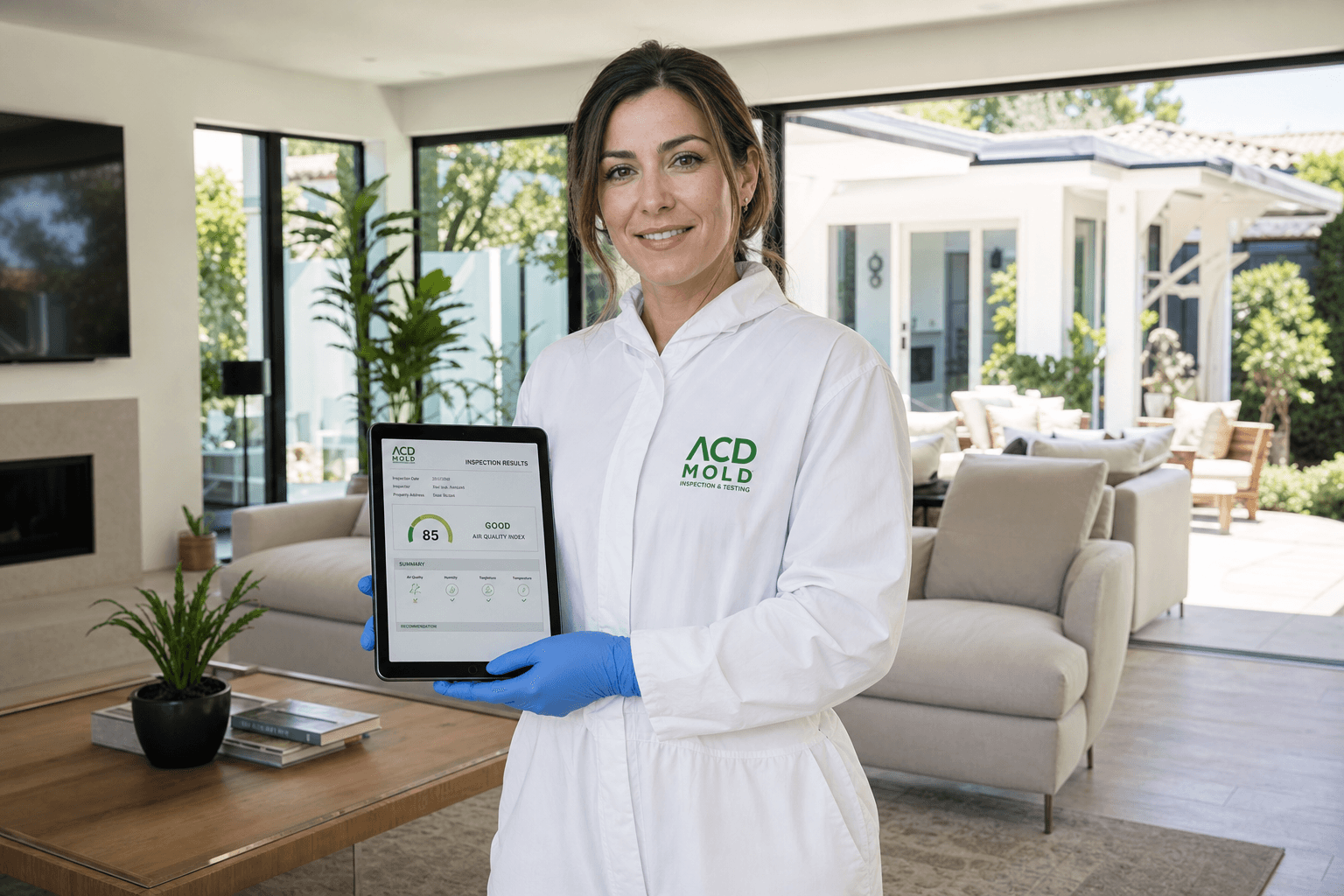
ACD Mold is based here in Encino, so a mold inspection on the Westside of the Valley is close to home for us. We diagnose and test; we do not sell removal, which means our report tells you what is actually there rather than what would be profitable to tear out. A standard visual and moisture inspection maps where water is getting in and whether conditions favor mold growth across mid-century ranch homes, hillside estates, and Ventura Blvd condos. This page explains what the appointment covers, what it costs, when lab testing is worth adding, and how removal is handled if it turns out you need it.
What a mold inspection covers in Encino
A mold inspection is a diagnostic visit, not a cleanup. The goal is to find the moisture source and document the extent of any growth so you can make an informed decision. An inspector walks the property, checks the areas where water tends to collect, and uses instruments to find problems that are not visible to the eye.
We use FLIR thermal imaging, moisture meters, and borescopes. It helps to be clear about what these tools do: thermal cameras read surface temperature differences and moisture meters read the moisture content of a material. They flag cool, damp spots behind a wall or under a floor that are worth investigating. They do not 'see mold' through drywall. Where a reading is suspicious, a borescope lets us look inside a cavity through a small hole rather than opening the whole wall.
The inspection is non-invasive by default. If visible mold is already present, the inspection focuses on confirming the extent and, more importantly, finding and documenting the water source feeding it, because mold that is cleaned without fixing the moisture simply comes back.
- Bathrooms, kitchens, and laundry areas where plumbing and humidity concentrate
- Under-sink cabinets, around water heaters, and behind appliances
- Window frames, wall cavities, and ceilings below roof lines or upper-floor baths
- Crawl spaces, subfloors, and the base of exterior stucco walls
- HVAC supply areas and condensation-prone cool wall cavities
Why the Valley's climate and housing make moisture a real issue
Encino sits in the inland San Fernando Valley, where hot, dry summers and noticeably cooler nights are the norm. That daily temperature swing is relevant to mold: warm, humid indoor air meeting a cool wall cavity or an air-conditioned surface can produce condensation, and condensation is moisture that mold can use. This is general building science for the area, not a claim about your specific home.
The local housing stock also matters. Encino mixes mid-century ranch homes, hillside estates, and condos along the Ventura Blvd corridor, roughly spanning the 91316 and 91436 ZIP codes and neighborhoods like Encino Hills and Royal Oaks. Mid-century homes frequently still have aging copper or galvanized plumbing, and a slow pinhole leak or a corroded joint can wet a wall cavity for a long time before anyone notices a stain.
Hillside lots carry their own patterns. Slope seepage after rain and irrigation overspray hitting stucco can keep the lower exterior of a wall damp. None of this guarantees a problem, but these are the realistic ways water reaches places it should not in this part of the Valley, which is why an inspection looks specifically for them.
What to expect at the appointment
A typical residential inspection takes roughly one to two hours depending on the size of the home and how many problem areas there are. You do not need to prepare much; it helps to clear access to under-sink cabinets, the water heater, and any closet or wall where you have seen staining or smelled a musty odor.
The inspector documents findings with photos and thermal images, notes moisture readings, and identifies the likely moisture source. If removal is warranted, the report describes the scope so that any qualified contractor can bid it accurately. You receive a written report, typically within 24 to 48 hours.
Because ACD does not perform removal, the report is written to be useful to you and to whichever contractor does the work, rather than steering you toward a particular job. If nothing significant is found, the report says so plainly.
Honest pricing and timing
A standard residential mold inspection runs $295 to $595. The range reflects property size, number of areas to assess, and site access, such as a hillside crawl space versus a single-story ranch.
Lab testing is optional and priced per sample on top of the inspection: roughly $95 per surface (tape or swab) sample, and $145 to $195 per air sample. Air samples are typically collected in pairs so that indoor results can be compared against an outdoor baseline taken the same day. Many inspections do not need any samples at all; see the next section.
Written reports are generally delivered within 24 to 48 hours. When lab analysis is included, timing depends on the accredited laboratory's turnaround, which we will tell you up front.
- Standard residential inspection: $295-$595
- Surface sample (tape/swab) with lab analysis: about $95 each
- Air sample with lab analysis: $145-$195 each
- Written report: typically 24-48 hours
When testing helps and when it doesn't
Testing is frequently oversold, so it is worth being direct about what it can and cannot do. A sample characterizes what was collected at that spot and that moment, and air sampling compares an indoor spore count against an outdoor baseline. Testing does not diagnose any illness, and it cannot certify a building 'safe.' There are no EPA or federal limits for airborne mold or spores to pass or fail against, and California public-health guidance does not set health-based spore thresholds either.
Following EPA guidance, if mold is already visible, sampling is usually unnecessary: you can see the problem, and the response is the same regardless of what a lab names the species. The EPA also notes that a patch smaller than about 10 square feet can often be cleaned by a homeowner taking proper precautions. That 10-square-foot figure is EPA's do-it-yourself-versus-professional guideline, not a California legal threshold and not a CDPH rule. California's Department of Public Health recommends promptly removing all visible mold and fixing the moisture source, using no size cutoff and advising against routine measuring.
On the 'black mold' question: the CDC states that a causal link between Stachybotrys, often called black mold, and serious illness in otherwise-healthy people has not been established, and that black mold is not a distinct diagnosis. The practical takeaway is consistent across agencies: any indoor mold should be removed regardless of species, and the moisture fixed. People with asthma, mold allergies, or a compromised immune system may react more strongly, which can be a reason to act sooner. Testing is most useful when there is a musty odor or a known water history but no visible growth, when you need an indoor-versus-outdoor comparison, or as independent post-removal clearance.
If removal is needed: licensed partners and independent clearance
ACD Mold performs inspection, AIHA-accredited lab testing, and independent clearance. We do not perform the physical removal, and that separation is intentional. The party diagnosing the problem and verifying the fix is not the party paid to tear out drywall, so there is no incentive to overstate the scope.
When removal is warranted, we can coordinate licensed, insured remediation partner crews, and you are equally free to hire your own contractor. California does not issue a mold-specific license; remediation is performed under a California State License Board (CSLB) contractor license, commonly a B general or a C-61/D-64 classification, held by the crew doing the work. ACD does not claim to hold a mold removal license because no such license exists.
After removal, we can return for independent clearance. Clearance means the previously affected area shows no visible growth and, where air sampling is used, indoor spore counts are at or below the outdoor baseline. Because we were not paid to do the removal, that verification is genuinely independent.
Scheduling an inspection
If you have seen staining, noticed a persistent musty smell, had a recent leak or roof issue, or you are in a real-estate transaction and want an objective assessment, an inspection is the sensible first step. Catching a moisture problem early matters: the EPA notes mold can begin growing within 24 to 48 hours of water intrusion, so a leak found this week is a much smaller problem than the same leak found in a month.
Call ACD Mold at (424) 352-7039 to schedule. We are based in Encino and our inspectors travel to you throughout the San Fernando Valley; there is no storefront to visit. We will ask a few questions about what you are seeing so we can plan the right scope before we arrive.
Authoritative Sources Referenced
ACD Mold's inspection and testing protocols — and the remediation partners we coordinate — follow the published guidance of the recognized authorities below. Click through to verify any statement on this page:
- U.S. Environmental Protection Agency — Mold
- Centers for Disease Control and Prevention — Mold
- IICRC S520 Standard for Professional Mold Remediation
- American Industrial Hygiene Association (AIHA) Laboratory Accreditation Programs
- California Department of Public Health — Indoor Air Quality
- OSHA — Mold Health Hazards