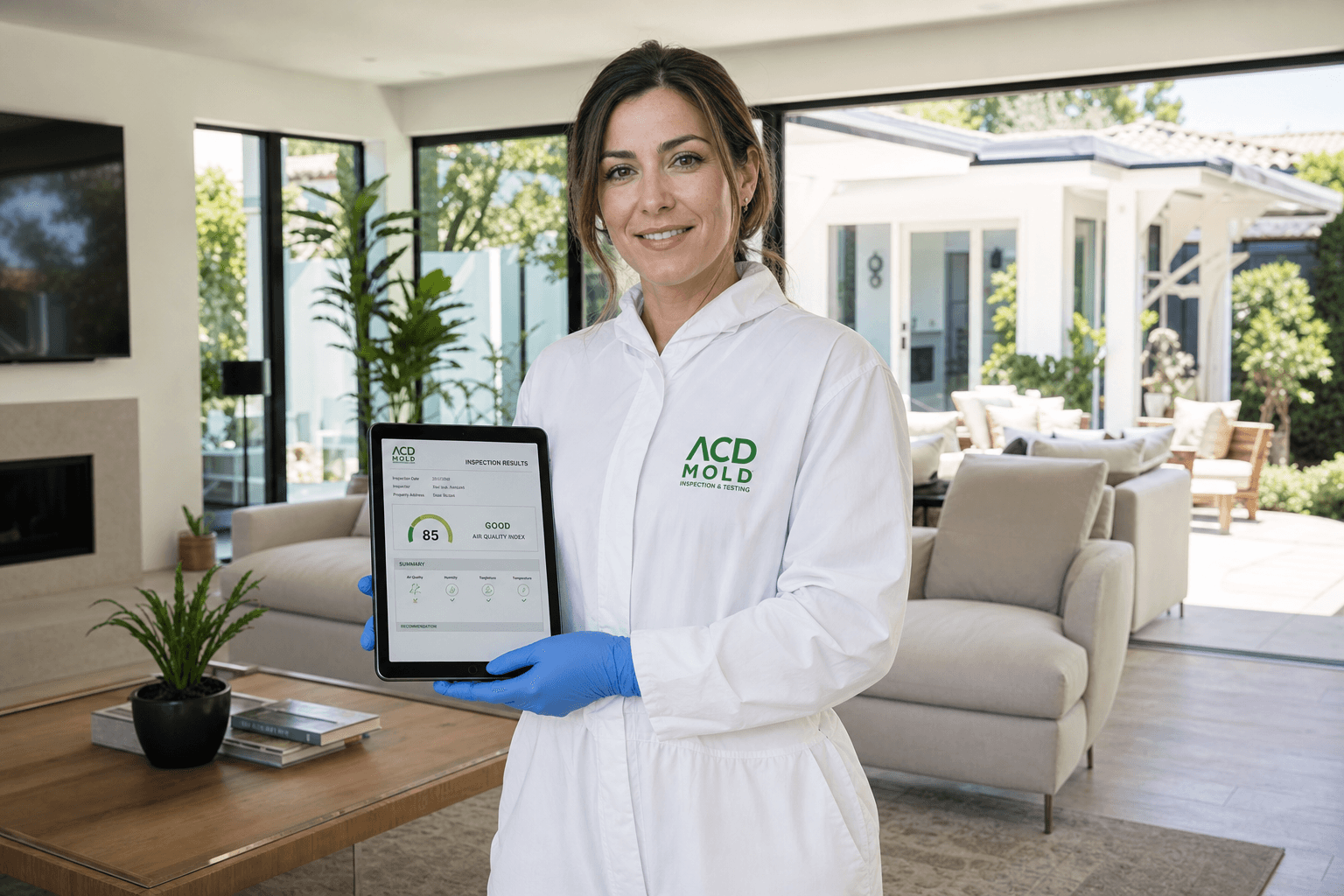
If a musty smell lingers, a stain keeps spreading across a ceiling, or paint bubbles in the same spot no matter how often you repaint, a mold inspection tells you what is actually happening behind the surface. ACD Mold is an independent inspection and testing company serving Burbank and the wider San Fernando Valley. We diagnose moisture and verify work, but we do not sell the removal, so our findings are not steered by a repair invoice. Inspectors travel to you across Magnolia Park, the Rancho Equestrian district, the Burbank Hills, and the 91501 through 91506 ZIP codes. Call (424) 352-7039 to talk through what you are seeing.
What a Burbank mold inspection covers
A standard inspection is a non-invasive, visual assessment combined with instrument readings. We walk the areas you are worried about and the common places moisture collects, look for active water intrusion, and trace it to a source. The goal is a clear answer: is there a moisture problem, where is it coming from, and does anything need to be removed.
Thermal cameras and moisture meters are diagnostic aids, not X-ray vision. They reveal temperature and moisture differences inside walls, floors, and ceilings that often point to a hidden leak or trapped dampness, but they do not see mold through drywall. When readings suggest a problem in a concealed cavity, we say so plainly and describe what limited further investigation would involve rather than guessing.
- Visual survey of the areas of concern and typical trouble spots
- Thermal imaging to flag temperature and moisture differentials
- Moisture-meter readings on suspect surfaces
- Checks of common sources: under-sink plumbing, bathrooms, roofline, attic, HVAC condensation, and any crawlspace or detached structure
- Identification of the moisture source driving the growth
- A written report delivered in 24 to 48 hours
Why moisture hides in Valley homes
Burbank sits in the inland San Fernando Valley, where summers are hot and dry rather than coastal and humid. That means most mold here is not driven by outdoor air; it is driven by water that gets in and cannot dry out. Heavy air-conditioning use through long warm seasons adds its own risk, because condensation can form at ducts, registers, and poorly drained condensate lines.
The city's housing mix shapes where problems show up. Post-war bungalows in neighborhoods like Magnolia Park often still carry portions of their original plumbing, where aging supply lines and drain fittings are a frequent slow-leak source. Homes built into the Burbank Hills can see slope seepage push moisture against foundations after rain. In the Rancho Equestrian district, detached garages, barns, and outbuildings often have limited ventilation, so dampness settles and stays. These are general patterns for the area, not a claim about any specific address; your inspection is about your home.
What to expect at the appointment
An inspector starts by talking through your history: what you have noticed, when it started, any past leaks or roof work, and whether anyone in the household has asthma, allergies, or a weakened immune system. That context focuses the visit, which is usually completed in a single trip of an hour or two depending on the size of the home and how many areas are involved.
You are welcome to follow along. If we find visible mold, we will tell you on the spot and explain the next steps; the written report that follows documents the findings, photos, moisture readings, and the recommended path forward.
Honest pricing and timing
A Burbank mold inspection runs $295 to $595. Where you land depends on the size of the property and how many areas need assessment; a single bathroom is at the lower end, while a whole house with an attic, crawlspace, and detached structures sits higher.
If laboratory testing makes sense, surface sampling is about $95 per surface and air sampling is $145 to $195 per sample. Testing is an add-on, not an automatic upsell, and we recommend it only when it answers a real question. Reports are delivered within 24 to 48 hours of the visit, including any lab results.
When testing helps, and when it does not
The EPA's guidance is straightforward: if mold is already visible, sampling is usually unnecessary, because you already know it needs to be removed and the moisture source fixed. Paying to confirm what your eyes can see rarely changes the plan, and we will tell you when that is the case.
Testing earns its cost in specific situations: a persistent musty odor or symptoms with no visible growth; comparing indoor air against an outdoor baseline; documentation for a real-estate transaction or dispute; or verifying that a completed cleanup worked. It helps to be clear about limits, though. Air sampling, run on standard cassettes at roughly 15 liters per minute, characterizes the spores in that sample at that time and place and compares them to an outdoor reference. It does not diagnose illness and cannot certify a building 'safe.'
On health questions, we follow the public-health consensus rather than marketing. There are no EPA or federal limits for airborne mold and no health-based spore thresholds. 'Black mold' is not a distinct medical diagnosis, and the CDC notes that a causal link between it and serious illness in otherwise-healthy people has not been established. The takeaway is the same regardless of species: any indoor mold should be removed and the moisture fixed, and people with asthma, mold allergies, or immune compromise may react more strongly.
If removal is needed: licensed partners and independent clearance
ACD Mold does not perform the physical removal, and that separation is deliberate. The party diagnosing a problem and verifying the cleanup should not be the party paid to do the removal. It keeps our findings and our sign-off honest.
California does not issue a mold-specific license. Remediation is performed under a standard CSLB contractor license, commonly a B general or a C-61/D-64 classification, held by the crew doing the work. For small jobs, the EPA's general guidance is that a visible patch under roughly 10 square feet can often be cleaned by a homeowner taking sensible precautions. That figure is DIY-versus-pro guidance, not a legal trigger or a California rule; CDPH simply recommends promptly removing all visible mold and fixing the moisture source, with no size threshold.
When professional removal is warranted, we can coordinate licensed, insured remediation partner crews, or you are free to use your own contractor. Either way, once the work is done we return independently to perform clearance: confirming there is no remaining visible growth and that indoor spore counts have come back to or below the outdoor baseline.
Your next step
If something has you concerned, the most useful step is to get it looked at before you open walls or book removal. Call ACD Mold at (424) 352-7039 to describe what you are seeing and schedule an inspection anywhere in Burbank. You will get a clear reading of the situation and a written report you can act on, whether that means a simple fix, a cleanup, or nothing at all.
Authoritative Sources Referenced
ACD Mold's inspection and testing protocols — and the remediation partners we coordinate — follow the published guidance of the recognized authorities below. Click through to verify any statement on this page:
- U.S. Environmental Protection Agency — Mold
- Centers for Disease Control and Prevention — Mold
- IICRC S520 Standard for Professional Mold Remediation
- American Industrial Hygiene Association (AIHA) Laboratory Accreditation Programs
- California Department of Public Health — Indoor Air Quality
- OSHA — Mold Health Hazards