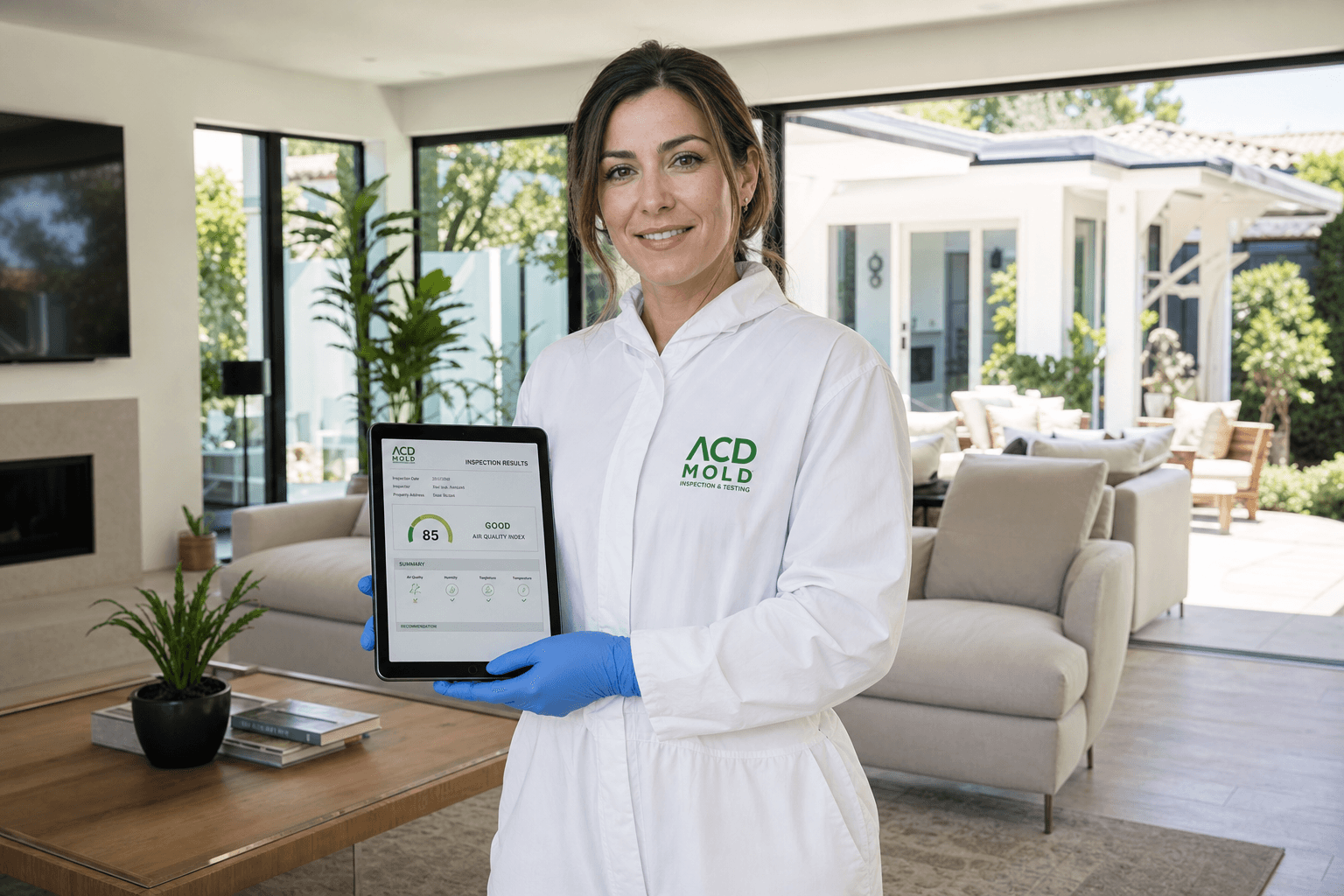
A mold inspection in Beverly Hills is usually about catching a moisture problem before it damages high-end finishes, original plaster, or built-in cabinetry. ACD Mold is an independent inspection and testing company based in Encino; our inspectors travel to your property, so there is no storefront in Beverly Hills. We diagnose and, when you choose to test, send samples to an AIHA-accredited lab. We do not perform the physical removal ourselves, which keeps our findings independent of any removal invoice.
What a mold inspection covers here
A standard visit is a non-destructive walkthrough aimed at finding where moisture is collecting and whether conditions favor mold growth. The inspector reviews the history of the concern with you, then works through the areas most likely to hold water: under-sink cabinets, behind and beneath appliances, around windows and skylights, water heater and laundry areas, bathrooms, subgrade rooms, attics, and anywhere you have noticed staining, a musty odor, or a past leak.
We use a FLIR thermal camera and a moisture meter to find temperature and moisture differentials behind surfaces, and a borescope to look inside a wall cavity or ceiling through a small, discreet access point when something needs confirming. It is worth being clear about what the tools do: a thermal camera and moisture meter detect temperature and moisture differences, not mold itself. No instrument sees mold through a wall. They tell us where water is, which is what points us to a hidden problem.
Why Beverly Hills properties are worth inspecting carefully
Much of the housing stock here raises the value of early, non-invasive detection. Large estates and historic Spanish-revival homes often have original plaster walls that hide moisture longer than modern drywall and are expensive to open and restore. Finding a leak through thermal imaging before anyone cuts into plaster can be the difference between a small repair and a major one.
The 90210 hills add drainage questions: hillside grading, retaining walls, and landscape irrigation can push water toward a structure, and lower-level or subgrade rooms are the usual place it shows up. Larger homes also tend to run complex, multi-zone HVAC systems, where condensation can form at supply registers, in ducting, or around air handlers in closets and attics. These are exactly the quiet, out-of-sight sources a thermal and moisture inspection is designed to surface before high-end finishes are affected.
What to expect at the appointment
A typical inspection of a single-family home takes roughly one to two hours; larger estates take longer and are scoped accordingly. The work is discreet and non-invasive by design, which matters in occupied homes and staged properties. We keep access points small and, where a borescope is needed, use existing openings or a minimal, patchable access point rather than opening finished walls.
You receive a plain-language report describing what was observed, where moisture was detected, photos and thermal images, and clear recommendations. If visible mold is present, the report says so; if the real issue is a moisture source that needs fixing, it says that instead. The goal is to help you decide, not to upsell a service we do not perform.
Honest pricing and timing
A standard thermal and moisture inspection runs $295 to $595. Larger estates with multiple structures, extensive square footage, or complex access scope higher, and we confirm the range with you before the visit based on the property. Appointments can often be scheduled quickly, and the written report typically follows within a day or two depending on whether lab testing is included.
Testing is an optional add-on, not a default. If you choose to sample, surface (tape or swab) samples are about $95 per surface, and air samples are $145 to $195 per sample. Lab turnaround adds a short wait because samples are analyzed by an independent AIHA-accredited laboratory rather than read on site.
When testing is and isn't needed
Testing is useful in specific situations, but it is not automatic. The EPA notes that when mold is already visible, sampling is usually unnecessary: you can see the problem, and the response is the same regardless of the lab result. The California Department of Public Health goes further, recommending prompt removal of all visible mold and repair of the moisture source, using no size threshold and advising against routine measuring. There are no EPA or federal limits for airborne mold or spores, and no health-based spore thresholds to pass or fail against.
Where testing earns its place is when mold is suspected but not visible, when you want to characterize air quality before or after work, or when a tenant, buyer, or seller wants an independent read. A test characterizes the specific sample taken at that time and place and compares indoor levels to an outdoor baseline; it does not diagnose illness and it does not certify a building 'safe.' For air sampling we run Air-O-Cell cassettes at the correct flow rate and always pair indoor samples with an outdoor baseline for context.
- Visible mold present: usually no test needed; the fix is to remove it and correct the moisture source.
- Suspected hidden mold, a musty odor, or a past leak: inspection first, targeted testing only if it will change the decision.
- Real-estate or landlord/tenant questions: independent air or surface sampling can provide an impartial record.
- Post-removal confirmation: clearance testing to verify the work before walls are closed.
About 'black mold' and health
Many calls start with worry about 'black mold,' so it is worth stating what the public-health agencies say. The CDC notes that a causal link between Stachybotrys (often called black mold) and serious illness in otherwise-healthy people has not been established, and that 'black mold' is not a distinct diagnosis. At the same time, any indoor mold should be removed regardless of species, and people with asthma, mold allergies, or weakened immune systems may react more strongly. The practical takeaway is steady rather than alarming: find the moisture, remove the growth, and fix the source.
If removal is needed: licensed partners and independent clearance
ACD Mold does the diagnosis and, when you choose, the testing and the final clearance. We do not perform the physical removal. When removal is warranted, we coordinate licensed, insured remediation partner crews, or you are welcome to use your own contractor. California has no state mold-specific license; remediation is performed under a CSLB contractor license (commonly a B general or a C-61/D-64 limited-specialty classification) held by the crew doing the work.
After removal, we return as an independent party to verify the result rather than grading our own work. Clearance means spore counts at or below the outdoor baseline with no visible growth remaining. Keeping the party that verifies separate from the party paid to remove is the point: our clearance means something precisely because we were not paid to tear out the material.
Next step
If you have seen staining, noticed a musty smell, or had a leak in a Beverly Hills home, from the Flats to Trousdale to the 90210 hills, a thermal and moisture inspection is a low-disruption way to find out what is actually going on. Call ACD Mold at (424) 352-7039 to describe the situation and schedule a visit, and we will give you an honest read on whether an inspection, testing, or simply fixing a moisture source is the right next move.
Authoritative Sources Referenced
ACD Mold's inspection and testing protocols — and the remediation partners we coordinate — follow the published guidance of the recognized authorities below. Click through to verify any statement on this page:
- U.S. Environmental Protection Agency — Mold
- Centers for Disease Control and Prevention — Mold
- IICRC S520 Standard for Professional Mold Remediation
- American Industrial Hygiene Association (AIHA) Laboratory Accreditation Programs
- California Department of Public Health — Indoor Air Quality
- OSHA — Mold Health Hazards