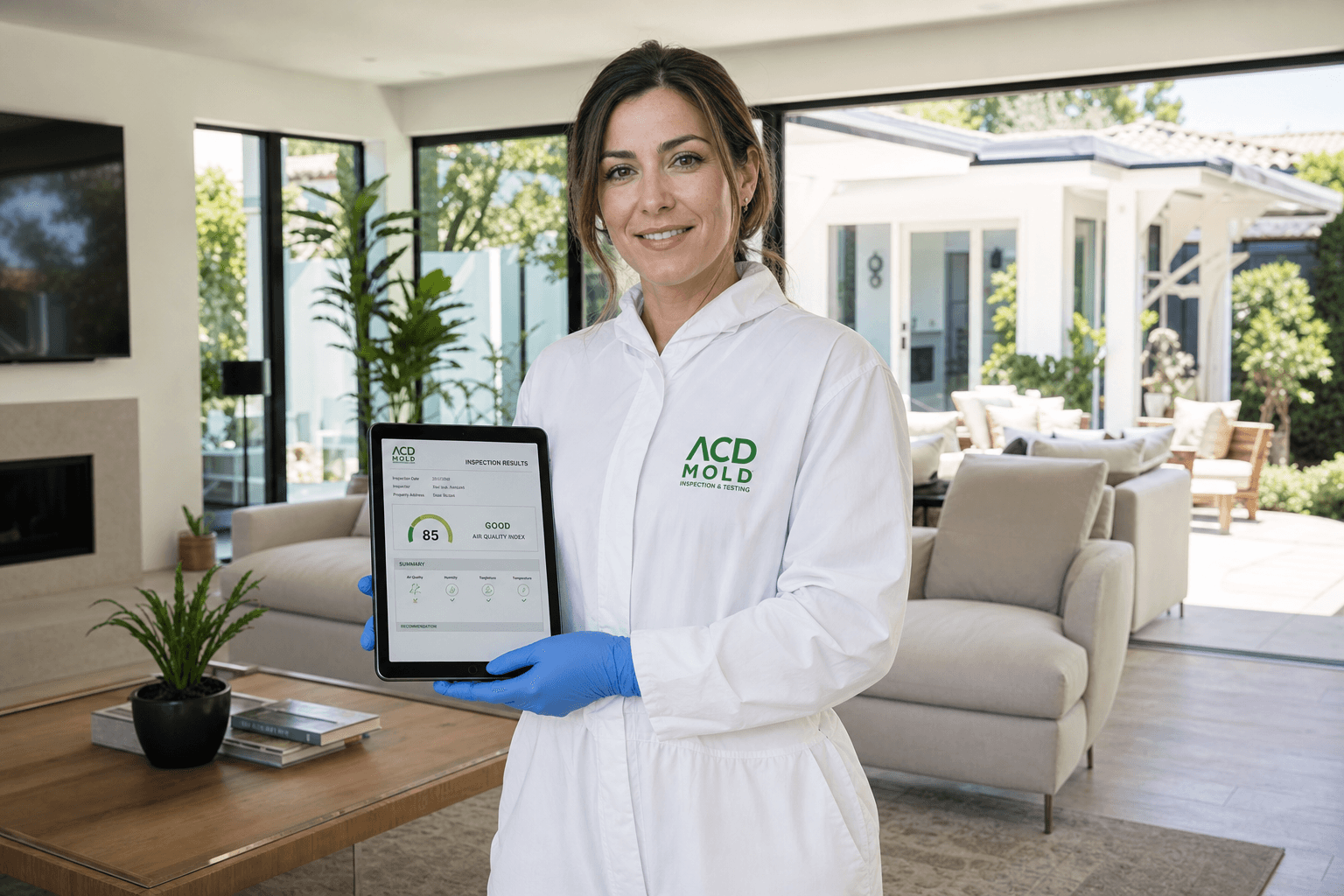
ACD Mold provides independent mold inspection for homes across Altadena, from the Craftsman bungalows near Christmas Tree Lane to the foothill properties above the Meadows. We diagnose and test; we do not sell removal, so our only job on-site is to tell you honestly what is there and what, if anything, needs to happen next. Our inspectors travel to you throughout the San Gabriel Valley from our Encino HQ, and a typical visit combines a visual survey with thermal imaging and moisture readings so you get a clear picture without tearing into walls.
What a mold inspection covers here
A mold inspection is a diagnostic visit, not a cleaning service. The inspector walks the property looking for visible growth, water staining, and the conditions that let mold start, then uses a thermal camera and a moisture meter to find temperature and moisture differentials behind finishes. It's worth being clear about what those instruments do: they reveal where surfaces are cooler or damper than they should be, which points to hidden water. They do not 'see mold' through a wall.
In Altadena specifically, we spend time on the places foothill homes tend to collect moisture: crawlspaces and foundations downhill of a slope, older galvanized or cast-iron plumbing, bathrooms and laundry areas in homes built before modern ventilation was standard, and roof-to-wall junctions on long-eaved Craftsman rooflines. The goal is to connect any mold we find back to its moisture source, because per both the EPA and the California Department of Public Health, mold cleaned without fixing the water will simply return.
Why Altadena's homes and climate matter
Altadena sits against the San Gabriel foothills, and that setting shapes the moisture problems we're asked to look at. Many homes are historic Craftsman and early-twentieth-century construction with original or patchwork plumbing, wood framing, and foundation details that predate modern drainage. On sloped lots, runoff and irrigation naturally drain toward the uphill side of the foundation, and over years that can keep crawlspaces and lower walls damp. The EPA notes mold can begin growing within 24 to 48 hours of water intrusion, so a slow leak or chronically wet crawlspace is often where a problem starts long before anyone sees a spot.
The January 2025 Eaton Fire affected Altadena, and we mention it plainly because it changes what some local inspections are about. Homes fought with large volumes of firefighting water, and homes undergoing rebuild with assemblies left open to weather, can take on moisture that leads to growth in framing and insulation. If your property is fire-adjacent or in reconstruction, an inspection can document moisture conditions in the structure before new finishes go back on top. This is ordinary building science, not a reason for alarm.
What to expect at the appointment
A standard inspection usually takes one to two hours depending on the size and layout of the home. The inspector will want access to the areas that matter: under sinks, bathrooms, the laundry connection, the attic and crawlspace if reachable, the water heater, and any room where you've noticed an odor, a stain, or past water. Sharing the history helps, such as a prior leak, a roof repair, or when an odor first appeared.
You'll get a walkthrough of what the inspector is seeing in real time, so there are no surprises in the report. If we recommend sampling, we'll explain why before anything is collected. The written report, delivered in 24 to 48 hours, documents observations, thermal and moisture findings, any lab results, and plain next steps.
- Clear access to under-sink cabinets, the attic, and the crawlspace where possible
- Note any history of leaks, roof work, or persistent odors
- Have pets secured and someone available to answer questions
- Allow roughly one to two hours for a typical single-family home
Honest pricing and timing
A thermal and moisture inspection runs $295 to $595, with the range driven by home size, the number of areas to assess, and crawlspace or attic access. The inspection itself is non-invasive. If lab testing is warranted, a surface sample is about $95 per surface, and air samples run $145 to $195 each. Sampling is quoted and discussed before we collect anything, so testing is always your choice, not a surprise line item.
We quote only these ranges because they're ours to stand behind. The written report follows in 24 to 48 hours, and it's yours to use however you wish, including with a remediation contractor of your own choosing.
When testing is worth it, and when it isn't
Testing gets oversold in this industry, so here is the straight version drawn from the primary authorities. The EPA's position is that if you can see mold, sampling is usually unnecessary; you already know you have mold, and the response is the same regardless of species. The CDPH recommends promptly removing all visible mold and fixing the moisture; it uses no size threshold and advises against routine measuring. There are no federal or California health-based limits for airborne mold or spores to compare your home against.
Testing earns its place in narrower cases: confirming whether a musty odor with no visible source reflects a hidden problem, establishing an indoor-versus-outdoor baseline, or verifying a cleanup. It's worth knowing what a sample can and cannot do. It characterizes the air or surface at that one place and time; it does not diagnose illness and cannot certify a building 'safe.' On health, the CDC notes that a causal link between so-called black mold or Stachybotrys and serious illness in otherwise-healthy people has not been established, and 'black mold' isn't a distinct diagnosis. Any indoor mold should be removed regardless of species, and people with asthma, mold allergies, or weakened immune systems may react more strongly.
- Visible mold present: usually skip testing, address the moisture and remove the growth
- Musty odor, no visible source: an inspection with targeted sampling can help locate it
- After a cleanup: a clearance test can confirm the work
- Small patches under about 10 square feet: EPA's guidance is these can often be handled by a homeowner taking precautions (this is DIY guidance, not a legal rule)
How removal and clearance are handled
This is where our structure matters. ACD performs inspection, AIHA-accredited lab testing, and independent post-remediation clearance. We do not do the physical removal ourselves. When removal is needed, we coordinate licensed, insured remediation partner crews, and you're equally free to hire your own contractor. There is no California state mold-specific license; remediation is performed under a CSLB contractor license, commonly a B or C-61/D-64, held by the crew doing the work.
The reason we keep those roles separate is simple: the party verifying the job should not be the party paid to perform it. After remediation, we return to independently check the work. Clearance means spore counts at or below the outdoor baseline with no visible growth remaining, confirmed with the moisture source corrected. That independence is the whole point of using us.
The next step
If you've noticed a musty smell, past water damage, or you're weighing an inspection before or during an Altadena rebuild, the practical move is a thermal and moisture inspection to find out what's actually going on. Call (424) 352-7039 to schedule, and we'll come to you anywhere in the 91001 area and across the San Gabriel Valley. You'll get a clear walkthrough on-site and a documented report within 24 to 48 hours.
Authoritative Sources Referenced
ACD Mold's inspection and testing protocols — and the remediation partners we coordinate — follow the published guidance of the recognized authorities below. Click through to verify any statement on this page:
- U.S. Environmental Protection Agency — Mold
- Centers for Disease Control and Prevention — Mold
- IICRC S520 Standard for Professional Mold Remediation
- American Industrial Hygiene Association (AIHA) Laboratory Accreditation Programs
- California Department of Public Health — Indoor Air Quality
- OSHA — Mold Health Hazards